Radio Ergo - Somali Humanitarian News and Information
  • Home
  • Topics
    • Latest Stories
    • IDPS/Refugees
    • Natural Disasters
    • Health
    • Social
    • Food Security
    • Education
    • Agriculture & Livestock
  • Programmes
    • Locust Programme
    • Farming Programme
    • Radio Doctor Programme
    • Women Programme
    • Entertainment Programme
  • About Radio Ergo
  • Contact Us
  • blankSomali
  • blankEnglish
No Result
View All Result
Radio Ergo - Somali Humanitarian News and Information
  • Home
  • Topics
    • Latest Stories
    • IDPS/Refugees
    • Natural Disasters
    • Health
    • Social
    • Food Security
    • Education
    • Agriculture & Livestock
  • Programmes
    • Locust Programme
    • Farming Programme
    • Radio Doctor Programme
    • Women Programme
    • Entertainment Programme
  • About Radio Ergo
  • Contact Us
  • blankSomali
  • blankEnglish
No Result
View All Result
Radio Ergo - Somali Humanitarian News and Information
Home IDPS/REFUGEES

Jobless Somali pastoralists hired to clear ‘parasite’ tree destroying farm and grazing lands

Radio Ergo by Radio Ergo
April 12, 2018
in IDPS/REFUGEES, LATEST STORIES
0
Somalia live news, Radio Ergo news, Humanitarian news, Somali live news

File Photo/Ergo

0
SHARES
Share on FacebookShare on Twitter

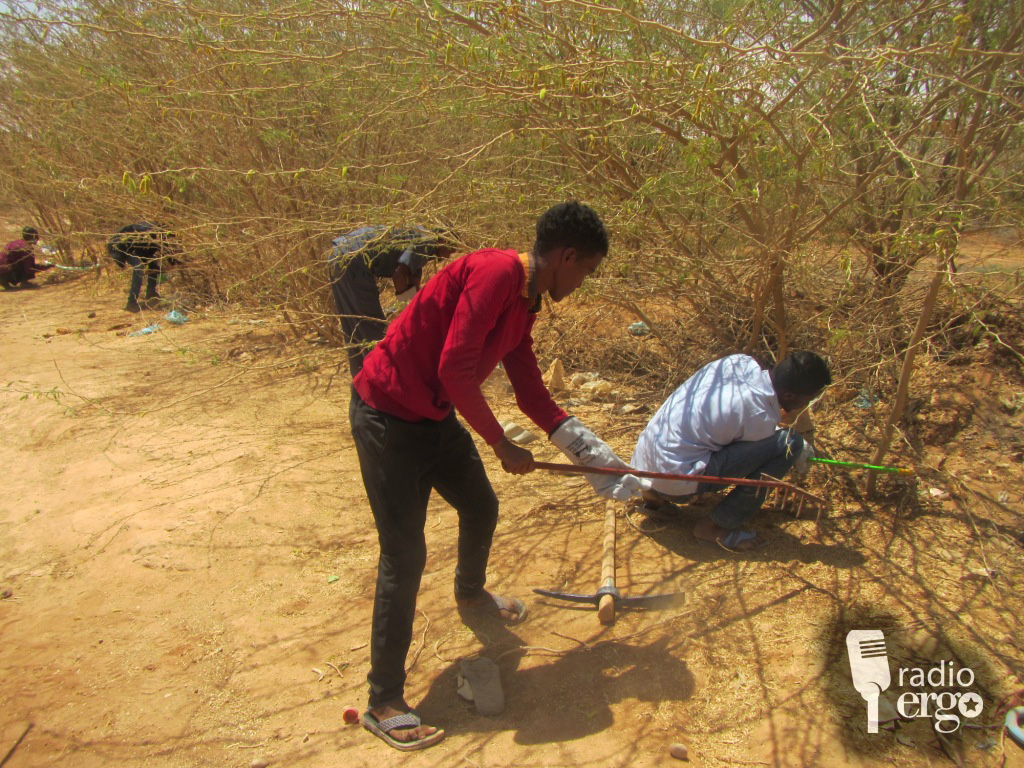
Displaced pastoralists in Somaliland’s drought-hit Togdher region are being paid to clear thickets of an invasive tree that is taking over farm and grazing land.

Around 600 families living in IDP camps in and around Burao have been hired for a two-month project by environmental group, Pastoral Environmental Network in the Horn of Africa (PENHA).  They are paid $82 a month to cut down and burn the Algobra trees, known locally as parasite trees.

Rowdo Adan Jama, 42, told Radio Ergo she was happy with the work scheme as she no longer had to worry about her nine children’s food.  They have been surviving on irregular aid in an IDP camp from humanitarian organizations. She used their first $82 salary to buy sugar, rice, flour, oil and milk.

Hassan Awil Dirir of PENHA said the parasite trees have been rapidly invading farmland in Burao and villages including Beer and Yirowe.  PENHA started the initiative, with support from the Food and Agriculture Organisation (FAO), to give livelihood support to destitute families whilst ridding the area of the plant menace.


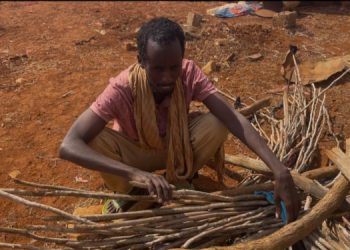
Work is being offered to people aged 25-50, who have no source of income. They are required work six days a week. The men cut down the trees then the women burn them.


Rowdo said her husband had no means of supporting the family after they lost their 180 goats and seven camels in the drought over the last two years. The have just 10 goats left.


Abshir Abdi Yusuf, 45, had spent more than a year in Siliga camp with his wife and six children in eastern Burao without any income.  He told Radio Ergo they had depended on occasional aid distributions, after losing 180 goats and 26 camels in Habura village, roughly 80 km south west of Burao. He was also very glad to get the work with PENHA, so as to be independent at least for a while.


The Algobra tree, or Prosopis Juliflora, is a very hardy plant that withstands drought because of its deep root system.   Introduced in the 1980s as part of reforestation experiments, the invasive tree has been taking over agricultural and grazing land and spreading fast in urban areas all over Somalia.

However, there are differing views among local people and experts as to how to deal with it.

According to Mohamed Farah, a lecturer in botany at the University of Burao, Algobra is not beneficial to people or livestock because of its exhaustion of water in the catchment areas, preventing other indigenous plants from growing.

Dr Hussein Haji, executive director of local agro-technology group SATG, said Algobra could be turned to people’s advantage:

“People don’t know what to do with it.  Some are proposing to cut the tree and use it as charcoal.

The pods can be used as animal feed, but unfortunately the plant has sharp spines and it is not easy to harvest the pods.  Cutting the tree and using it as charcoal is a way to slow down the spread of the tree and perhaps help reduce the cutting of acacia trees, which is generally used for charcoal.”

Previous Post

Somali famine refugees in Dadaab suffer cold nights awaiting imminent closure of their camp

Next Post

Women lawyers support domestic workers in Puntland with employment contracts

Related Posts

Airstrikes wipe out livelihoods in Lower Shabelle farming village
FOOD SECURITY

Airstrikes wipe out livelihoods in Lower Shabelle farming village

April 17, 2026
Somalia live news, Somalia latest news, Mogadishu live news, Somali news
FF Feedback

Radio Ergo audience feedback report 9-15 March 2026

April 17, 2026
Hard-up Awdal farmers turn to gold digging
FOOD SECURITY

Jobless men turn to gold mining in Sanag region

April 16, 2026
Marginalised families in Puntland displacement camps face hunger, discrimination and neglect
FOOD SECURITY

Selling thatching grass in Bari valley provides new income for drought-hit families

April 15, 2026
School closes as UNICEF cuts funding leaving IDP children in Baidoa out of education
EDUCATION

Schools close across Galmudug due to drought

April 14, 2026
Drought-hit Lower Juba pastoralists flee towards the Somali-Kenyan border
IDPS/REFUGEES

Drought-hit Lower Juba pastoralists flee towards the Somali-Kenyan border

April 13, 2026
Next Post
Job

Women lawyers support domestic workers in Puntland with employment contracts

FOLLOW US ON FACEBOOK

DAILY PROGRAMMES

IDAACADDA 17-APR-2026

IDAACADDA 17-APR-2026 by Radio Ergo

IDAACADDA 17-APR-2026
Episode play icon
IDAACADDA 17-APR-2026
April 17, 2026
Episode play icon
IDAACADDA 16-APR-2026
April 16, 2026
Episode play icon
IDAACADDA 15-APR-2026
April 15, 2026
Episode play icon
IDAACADDA 14-APR-2026
April 14, 2026
Episode play icon
IDAACADDA 13-APR-2026
April 13, 2026
Search Results placeholder
Radio Ergo Weekly Newsletter
We respect your privacy.
blank
blank
blank

© Copyright 2014 - 2024 Radio Ergo

No Result
View All Result
  • Home
  • Topics
    • Latest Stories
    • IDPS/Refugees
    • Natural Disasters
    • Health
    • Social
    • Food Security
    • Education
    • Agriculture & Livestock
  • Programmes
    • Locust Programme
    • Farming Programme
    • Radio Doctor Programme
    • Women Programme
    • Entertainment Programme
  • About Radio Ergo
  • Contact Us
  • blankSomali
  • blankEnglish

© Copyright 2014 - 2024 Radio Ergo