

This story is part of a special series resulting from a Radio Ergo reporting mission investigating the recent evictions of large numbers of IDPs from government buildings and private land in Mogadishu.
By Muhyadin Ahmed Roble
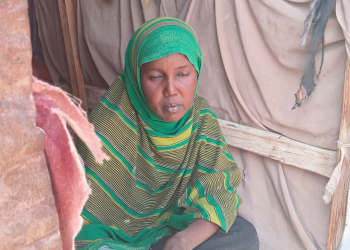
Hawo Abdirahman Abdi was hard at work washing clothes at the home of a middle class family in the neighborhood of Wardhigley when her phone rang. Doing laundry for the wealthy was how she made a living. She wiped her hands dry before answering the call.
“The camp has been destroyed and your children are with us. Come for them now,” said the distressed caller, a neighbour, on the other end of the phone.
It was around midday and Hawo, a mother of nine, could hear some of her children crying in the background. “They were crying like they didn’t know what was going on,” she recalled. She rushed back to the camp at Warshada Caanaha (the former Milk Factory), one of the capital’s largest camps hosting around 2,000 internally displaced people, who had fled conflict, drought and famine in the south.
“When I arrived at the camp, I could only seen armed men with government uniforms terrorizing the residents. I couldn’t get to my children immediately and everyone was running around in panic,” Hawo told Radio Ergo journalists. “It was just a like a typical warzone!” she added.
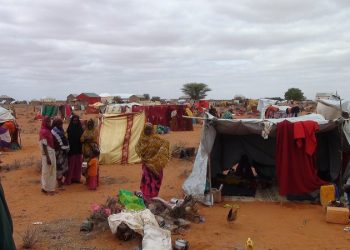
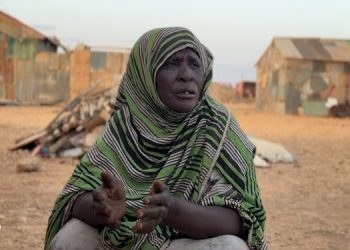
Hawo gave her interview to Radio Ergo in a new camp called Talo Rabbi in Sarkuusta, an area on the western outskirts of Mogadishu. Sarkuusta has received an influx of around 36,000 displaced people, mostly women and children, who were forcibly evicted from various camps in Mogadishu during 2014. They now live in overcrowded and unsafe settlements, lacking the basic amenities and services including water, electricity, clinics, and schools.
There are large tracts of non-adjudicated land in Sarkuusta, where self-appointed ‘gatekeepers’ have moved in and negotiated with indigenous people claiming ownership to set up the new IDP camps.
“We here are isolated people living on isolated land. There is nothing here and we have to go to Mogadishu for everything,” said Hawo, who moved to Sarkuusta after her house in the former Milk Factory in Hodan district was destroyed by government soldiers on 7 October 2014.
Transport between the camps and Mogadishu costs about $1 return. Most of the displaced people cannot raise the fare. The alternative two-hour walk to the city suits only the young or the strong.
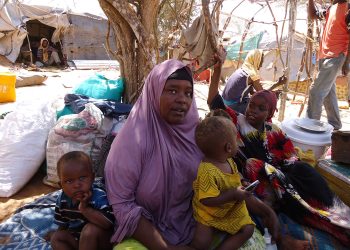
Hawo and her husband, a construction worker, now live with their nine children in a tiny makeshift hut strung together out of pieces of cloth and plastic sheeting. She was formerly a farmer in the agricultural rich district of Janale in Lower Shabelle region before fleeing to Mogadishu. She settled in the camp at the former Milk Factory and lived there for more than 10 years. It was there that she got married, gave birth and raised her children.
But Hawo is proud of the fact that she was never dependant on the food distributed by aid agencies. “We [her and her husband] both used to work to feed our children,” she said proudly. She usually found work as a porter or laundry woman, while her husband worked on building sites. On good days, together they managed to earn around 100,000 Somali shilling, roughly $5.
“But today he [her husband] is the only person working and feeding us because we can’t both afford transport to Mogadishu,” she said. Hawo’s plight is similar to that of thousands of other displaced people, who lost the small jobs they used to live on in Mogadishu. Banished to the outskirts of the city due to the ongoing forced evictions, their only option now is food aid – though they are not even sure if they will get it.
Mogadishu’s Deputy Mayor, Iman Nur Icar, told Radio Ergo in an interview that the country was at war at the moment and his administration could not resettle all the displaced people “today and tomorrow” within the city. However, Icar urged the displaced people to rent housing if they wanted to stay in Mogadishu. “They used to pay rent and some money to people claiming charge of the government buildings that had been turned into IDP camps. They should use that money to rent housing in the capital. They don’t have to go outside the city,” said Icar. Hawo Abdirahman Abdi, however, said they never used to pay rent when they stayed at Warshada Caanaha camp in Hodan.
This story is part of a special series resulting from a Radio Ergo reporting mission investigating the recent evictions of large numbers of IDPs from government buildings and private land in Mogadishu.