

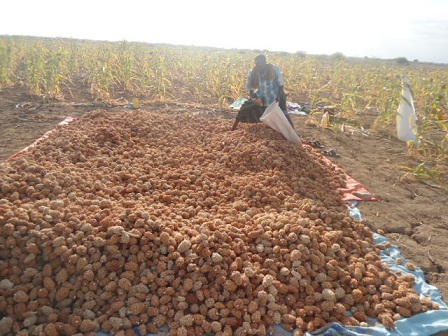
Farmers in Gedo say agricultural yields have dropped significantly in some parts of the region citing conflict and insufficient Deyr rains as the main causes.
Ismail Omar, a farmer in Serinley village, four kms from Bardere, said the region had experienced little rainfall this year compared to the same period in previous years.
“We are not hopeful because there is conflict in the area when we farmers are supposed to work hard in their farms. We are also worried about the emergence of drought if the lack of rains persists,” Ismail said.
His farm previously produced 400-500 sacks of sorghum. This season, he said it produced just 10 sacks.
“This problem is shared by all farmers in Gedo districts. The insufficient rainfall has also contributed to the decline of our farm production,” he said.
Abukar Ahmed, a farmer in Tubako village, 12 kms from Bardere, said farmers in the area planted various crops such as sorghum, maize, beans and sesame this year, but due to the minimal Deyr rains, most of them harvested far below expectations.
As a result of the low production, prices of food have skyrocketed, according to local residents in Bardere.
A 50 kg sack of local sorghum doubled from 150,000 Somali shillings in December to 300,000 Somali shillings currently.
Omar Mohamed, a farmer in Burdubo district, believes that conflict and the lack of agricultural support from aid agencies for the past four years were the main reasons for the failure.
“These combined problems can be said to be behind the predicament now facing farmers,” he said.
Gedo region in the southwest of the country, which was badly affected by the 2011 drought, is predominantly inhabited by farmers and pastoralist communities.
Conflict in many parts of this region has forced the displacement of a large number of farming families.