

(ERGO) – Government demolitions in Mogadishu have left low-income families struggling to afford food and housing, with small traders among those hardest hit after losing businesses, customers and often their homes.
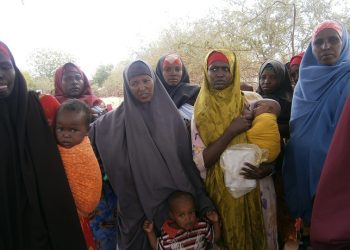
Many affected families have moved to Barwaaqo, Koris and Horyaal displacement camps in the city’s Daynile district after demolitions in August 2026 uprooted them and destroyed their livelihoods.
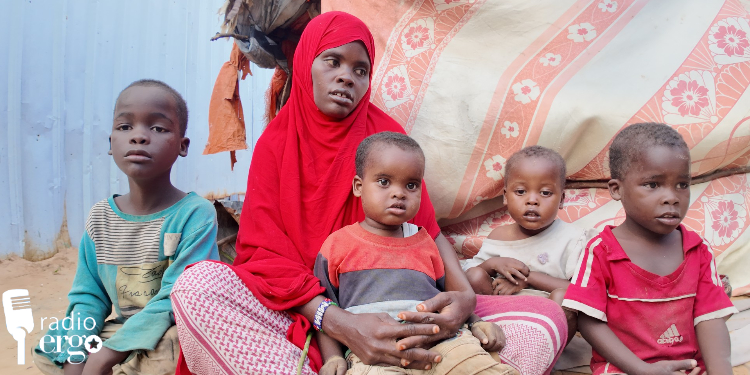
Khadija Abdullahi Hassan lost her home and the small business that supported her family of five children. For five years, she ran a stall selling chillies, groundnuts, biscuits, and sweets to residents of Tarabuush neighbourhood in Wadajir district. She made a daily profit of $8 to $9 that enabled her to reinvest in the business, rent a three-room house for $75 a month, and provide for her children.
Now she struggles to afford even one meal a day. Some of the established camp residents share small amounts of food with them, but the assistance can’t meet their needs.
“Our life is very difficult now. We have nothing to eat and nowhere to live,” Khadija told Radio Ergo. “I have three orphaned children and two children from my last marriage. I am also pregnant. I am struggling to look after all of them.”
Three of her children had to drop out of their Koranic classes that used to cost her $9 a month.
“I can’t afford to send them to school now. I have no money for their education,” she said. “Life in a displacement camp is extremely difficult – it is suffering with no way out.”
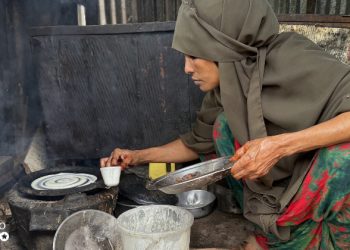
Halimo Ali Mohamed, 60, had supported her family of eight by making clay cooking stoves and selling flour, samosas, and other fried food in Hoolo-qalka neighbourhood in Dharkenley district. Her home was spared demolition, but she lost customers when other residents of the neighbourhood were displaced.
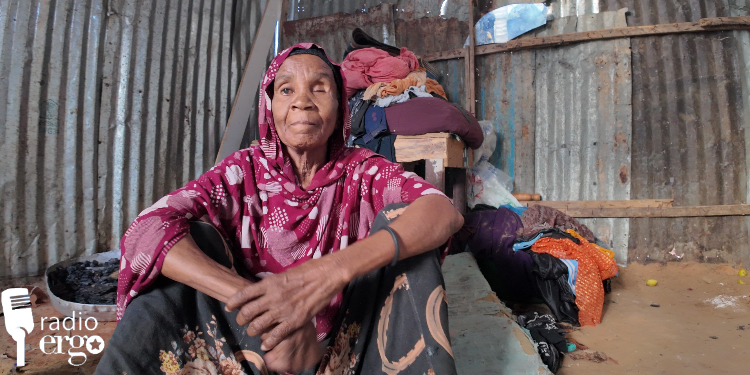
Her business collapsed as her customers fled so she could no longer afford the $100 monthly rent for her home. At the end of August, she moved her family to Horyaal camp to stay with relatives.
“We could not keep up with the rent, so we had to leave. Our landlord evicted us, and we brought our belongings with us. We have nowhere to sleep, and our clothes and other possessions are scattered outside,” she said.
The family depends on the little food that other camp residents, who are also struggling, can spare. Her daughter had to abandon her studies in Grade Four.
“I used to pay $5 a month for Koranic classes and another $5 for school, but I can no longer afford either,” she said
Halimo’s health puts her in a vulnerable position. She lost sight in her left eye after a measles infection. In July, she had surgery to remove a large tumour from her left shoulder and has not fully regained her strength.
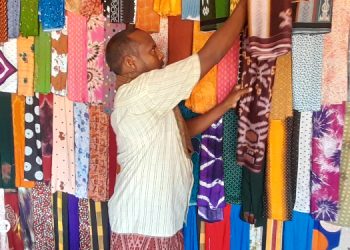
Faduma Abukar Ali is another small trader whose business was affected when bulldozers cleared the neighbourhoods. She had invested $200 in selling vegetables but lost her customers following the demolitions.
Her house was not demolished, but her loss of income left her unable to pay the $30 rent. She moved to Barwaaqo camp in mid-August with her eight children. They are staying with another family, without adequate shelter and short of food.
“Tonight we have nothing for supper. Rain is expected, but we have nowhere to shelter. I have nowhere to take my children if it rains,” she said. “We are staying with neighbours, who are already overcrowded. I have no work and no means to support myself and my children.”
Five of her children have stopped attending Koranic classes as she can’t afford the $25 monthly fees. Faduma said she has sole responsibility for raising her children since separating from her husband three years ago.
The chairperson of Koris camp, Maryan Muse Magoye, who is also a member of the Daynile displacement camps committee, said 235 families had been recently registered in the three camps in the district since the demolitions.
“They told us they had been displaced from the city, with some saying their homes had been demolished and others saying financial difficulties had left them unable to afford rent,” she said.
Some new arrivals had been given temporary plots to build shelters, while others brought corrugated iron sheets with them. Those who had previously rented homes arrived without materials to construct shelters, she said.
Maryan said the committee was seeking food and clothing assistance for the newcomers. Koris camp’s population has swollen to 1,800 families. Their agreement with the land owners expires in two years and they are seeking extension.
Economist Dr Shaafi Sharif Mohamed said rents in Mogadishu neighbourhoods had escalated, forcing the poor into IDP camps on the city’s outskirts.
“In Garasbaley, Kahda, Daynile and towards Gubadley, houses that used to rent for $20 to $30 now cost between $100 and $150,” he said.
He added that displacement disrupted children’s education, particularly those who had attended free government schools but could no longer access them after their families moved away from the city.