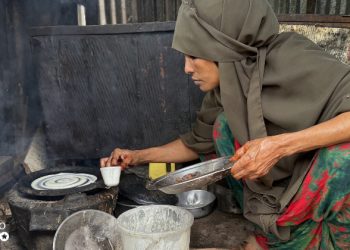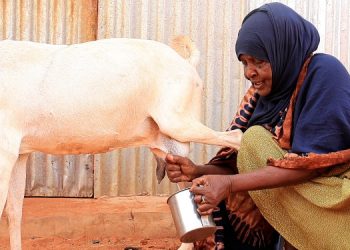


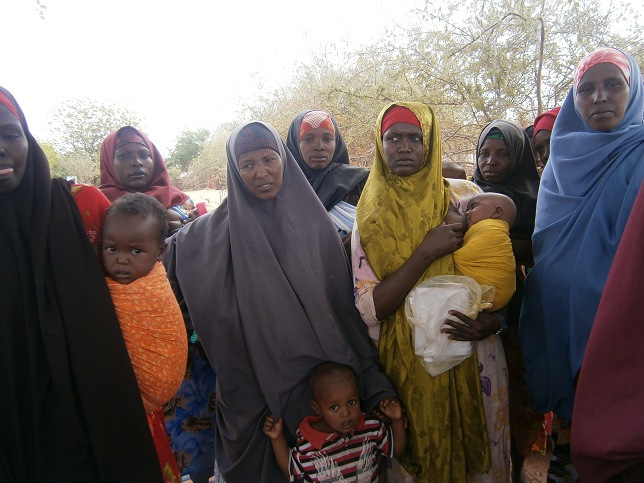
(ERGO) – Maymun Mohamed Abdi and her family had a narrow escape from Baidoa when their home was hit by a missile, causing panic among her young children.
Having never been displaced before, they had to flee for their lives and ended up in Afgoye, in a miserable camp.
“The fighting started at nine o’clock at night and continued until six in the morning. We all survived, but a shell destroyed my house. When the sun rose, I begged a truck driver to take us with him. We arrived here the following night,” Maymun told Radio Ergo.
Her five children, the youngest aged two, often go hungry in Iidle camp on the outskirts of Afgoye, where they arrived in late September.
They are among 150 families recently displaced by the conflict in Baidoa, in southern Somalia’s South West state. They arrived with nothing and have received no humanitarian aid, relying on occasional donations from other displaced families and local residents with a little to spare.
“We are suffering, we have nothing to eat. Some nights we go to bed hungry, while on other nights neighbours bring us a small amount of food in a bowl,” Maymun said.
Her children wake several times at night crying from hunger, she said, and with no food to give them she offers them water and promises to find something in the morning. Sometimes she boils leaves in water for them to drink.
Maymun also cares for her elderly husband, who has diabetes and high blood pressure. She said she begs households with piped water for a jerrycan every day because she can’t afford the 10 US cents charged for water from a well.
The family sleeps on the ground in a makeshift shelter without a mattress or any spare clothes. Rainwater seeps inside, leaving them exposed to cold.
“We have nothing to sleep on. We sleep on the sand, and when it rains, floodwater comes into our shelter. The cold has reached our bones,” she said.
In Baidoa, Maymun supported her family doing cleaning jobs and occasional farm work, earning $4 to $5 a day. She hasn’t been able to find any work in Afgoye.
Four of her children had to drop out of Koranic classes as she can’t afford the fees that are $5 per child in Afgoye, compared to a combined $8 a month in Baidoa.
Some of those recently displaced from Baidoa walked to Afgoye, while others paid for transport with their remaining money, or begged rides from cargo trucks like Maymun did.
Residents already in the camp are struggling with their own needs, limiting their ability to help.
Batulo Abukar Muhudin, a camp resident, has been collecting food, water, clothes and other essentials from households, businesses and farms for the new families. Other women help her, and they distribute whatever they collect to the most vulnerable families.
“I explain their circumstances to people, who give whatever they can. I find raw food for some families and cooked food for others,” she said.
Some families have built shelters from old cloth and branches, but they need plastic sheeting to protect themselves from the rain. Batulo said many newcomers were elderly and children without relatives in the area, staying in either a hall provided by the local administration, makeshift shelters, or with other families.
Batulo, who was diagnosed with diabetes five years ago, supports her family of 12 making baskets that sell for $2.50 each and collecting plastic containers for resale. She earns just $3 to $4 a day. When she feels well, she often sacrifices buying her diabetes medication to use the money to help displaced families.
The chairperson of Iidle camp, Fahmo Ali Idow, said the camp had hosted 450 families before the wave of new arrivals The administration transferred 20 families to another camp because there was no room for them.
“Those without food, water or a way to earn money face great hardship. They can’t return home because of the fighting, and here they have no source of income or idea where to begin,” Fahmo told Radio Ergo.
She said the camp lacked adequate water, shelter, health and education services. The administration had informed regional authorities and humanitarian organisations about the situation, but no assistance had arrived.