

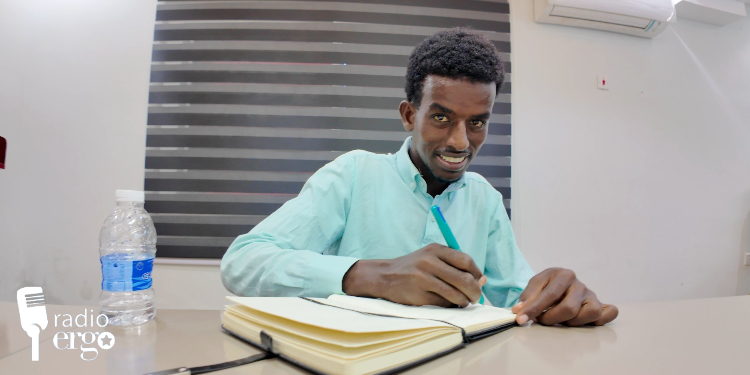
(ERGO) – Feysal Abdi Isaaq, 25, the eldest son in a family displaced from Baidoa, got himself through university whilst supporting his mum and eight siblings on the proceeds of peanut sales in the streets of Mogadishu.
After a social media post highlighted his circumstances as a poor student who had completed secondary school but could not afford university fees, the administration of Somali National University contacted him and offered him a scholarship.
Feysal graduated from Somali National University with a degree in social work this year, finishing eighth among the top 10 students in his faculty.
His family still depends on peanuts for income, although he hopes to find a better job following his graduation.
“The money we make selling peanuts is not usually enough to meet all our family’s needs, but we manage and keep going,” he said. “Money from the business enabled us to rent a decent house for $70 a month with three rooms and a bathroom.”
As the eldest child, he took responsibility for supporting the family at the age of 13 when his father died. Over 12 years he built up a regular customer base, earning $10 to $12 a day.
“I used to buy peanuts worth $50 because they were expensive and I couldn’t afford to buy more. Sometimes I sold everything before leaving the market, and other days I had just a little stock left,” he said.
He is looking now for a better paid job but hasn’t yet had any replies to his applications. Meanwhile, he has shown his sister the ropes and introduced her to his customers, so she can make the sales rounds in the afternoons.
“I go out around midday and come into town to look for work. I try to ask for opportunities wherever I think there might be a chance,” he said.
Balancing work and education wasn’t easy. He divided his time between classes and walking through the city streets selling peanuts, and was often teased by schoolmates.
“I was young and felt ashamed when students pointed at me saying, ‘Look at that boy our classmate out selling peanuts!’ But the work was important to me. Sometimes I hid from them, and other times I just ignored their comments,” he said.
“When I went to university, those students were good to me. They didn’t insult or discriminate against me. They respected me.”
He credited his mother’s constant encouragement and support for helping him achieve his ambitions.
“My mother saw that the effort I had put into my education had paid off. She had also worked hard to support me, and I was able to bring the results of that effort,” he said.
“I put a lot of effort into my university studies to achieve good results. I worked hard on the classes and assignments, studying step by step, semester by semester, until I finished eighth among the top 10 students.”
He tells other poor kids from displaced families, including those selling peanuts on the streets, to pursue their education. He tells them they can continue working while studying and points out that public schools under the Ministry of Education offer free education.
“I still encourage people living in displacement camps to study. They can make good progress through education while continuing with their work. Some accept the advice, while others say they are already struggling to survive and can’t go to school at the moment,” he said.
The family left Daryel IDP camp in Daynile in 2022, when Feysal’s earnings became sufficient to pay rent for a house in the city. They originally came to Mogadishu after fleeing drought in 2009 in Baidoa, where they owned a three-hectare farm growing cereals, sorghum, beans and various vegetables.