

(ERGO) – Children from pastoralist households who lost their livestock to drought are returning to classrooms in Jarriban, central Somalia’s Mudug region, where a private school has waived fees for pupils from poor backgrounds.
The children, aged six to 14, have been receiving free education since September, offering families who cannot afford school fees an opportunity to educate their children.
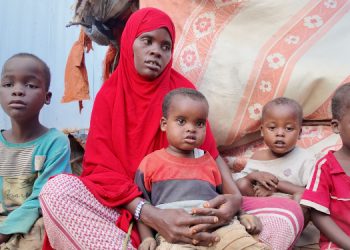
Samsam Abdi Mohamed enrolled her three children on 2 October after they had been out of school because she could not afford the $10 monthly fee per child. Her family moved to Jarriban in 2025 after losing most of its livestock.
“The teachers welcomed us and offered to teach our children for free,” she said. “My children used to feel discouraged when they saw other children their age going to school while they had no opportunity to study.”
Samsam accompanies her children to school each day and waits until classes finish before taking them home. Her family were pastoralists in rural Mudug for generations but moved to Jarriban in January 2025 after prolonged poor rainfall and disease killed most of their 150 goats and sheep.
“Of all the livestock we once had, only three goats are left,” she stated.
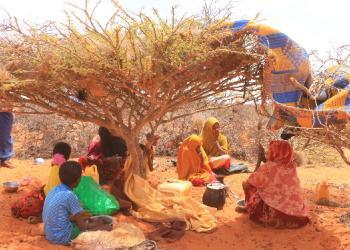
The family lives in Jaalle camp on the outskirts of Jarriban, in a shelter made from old clothes and wooden poles. Her husband goes into town daily to look for casual work, including at a stone quarry. His $3 odd earnings go towards providing meals.
Samsam has borrowed $27 to buy schoolbooks and uniforms for her three children. She faces frequent demands from a local shopkeeper to repay a separate debt of $260. The shopkeeper has threatened to have her husband arrested if the debt is not settled within two months because he stood as guarantor
Gelle Elmi Garad, a 56-year-old father of 10, has also struggled to provide education for his children after drought wiped out his livestock. He left the rural area of Teerage in Jarriban in April following three years of drought that destroyed their herd.
Four of his children have now enrolled in the school’s free education programme. Six other children grew up in the rural area without any schooling.
“Education is important. When I came to town, I intended to send one or two of my children to school. Their future will improve if they get an education,” he said.
Geelle spent the past five months looking for casual work in Jarriban but hasn’t found any. His family lives in two small shelters provided by relatives. The rooms are tiny so the adults sleep outside.
His wife sells milk in the neighbourhoods making about $2 a day. They sometimes receive help from relatives. He owes $500 to businessmen in his village for food, water and clothing he bought for his family, as well as for the cost of moving them to Jarriban.
“Some nights I manage to find something to bring home for the children to eat, but on other nights I return home with nothing,” he said.
The school introduced the free education programme after recognising that drought-affected families could no longer afford tuition fees.
School principal, Jama Abdullahi Mohamed, said hundreds of children had dropped out of education when support from the international agency CARE ended two years ago for teachers’ salaries, learning materials and school uniforms.
The school has waived $10 monthly fees for 210 children in grades one to three for this academic year. It has also opened opportunities for some parents who had never attended school to learn basic Somali reading and writing.
The school is currently supported by secondary school fees, small contributions from members of the local diaspora, and pro bono work and contributions by staff.
“We have a committee that conducts awareness campaigns and encourages people to bring their children. We do not ask parents to pay if they cannot afford the school fees,” the principal said.
“We make contributions ourselves. We supplement teachers’ salaries with what we collect from the secondary school. Sometimes, when there is no money, we persuade teachers to continue teaching their own community’s children for free.”
The school hopes to get support from organisations, the government and communities in the diaspora to enrol more children.
The initiative comes amid limited access to primary education in Puntland. A five-year education development plan released by the Puntland Ministry of Education in July 2026 found that only 33 per cent of children of primary school age were attending school, highlighting the barriers many families face in accessing basic education.