

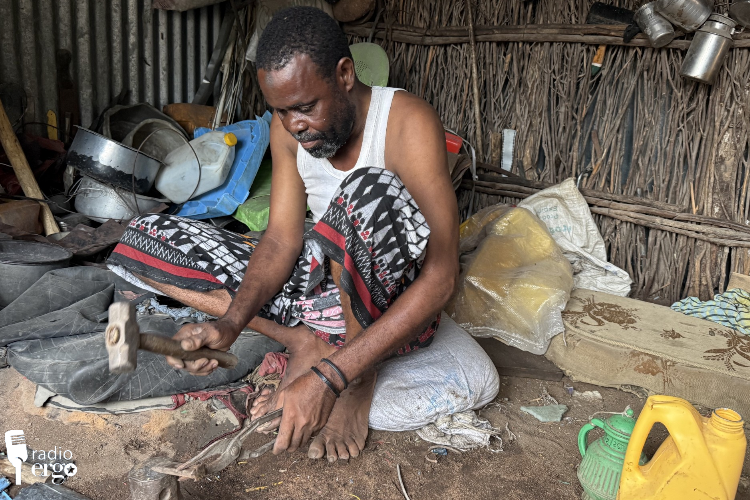
(ERGO) – Somali refugee metalworkers producing agricultural tools like hoes, axes and shovels, and household items including knives, cooking utensils and stoves, have lost customers as imported factory-made goods become more popular in the Dadaab refugee camps in northeastern Kenya.
Kamaal Mohamed Hussein, who worked as a metalworker for 10 years, closed his workshop in the camps in March due to a loss of customers. His family now struggles to afford regular meals.
“When good work stops, hunger is bound to come,” he said. “Women and children depend on their father for their needs. I go out looking for work, sometimes finding something and sometimes returning empty-handed. We can no longer afford our three daily meals or milk for the children.”
Kamaal’s family of seven receive refugee food aid consisting of 70 kilograms of sorghum and lentils and 17 litres of cooking oil every two months. He collects firewood, earning a maximum of $60 a month. It barely keeps the household going.
“I now use a donkey and cart. Sometimes I am away for two nights collecting firewood, which I sell for up to $20 per trip,” he said. “Sometimes I don’t sell anything for five days, but I go back out because I can’t sit idle. I make three or four trips a month. What I earn is not enough for my family, but this is the only work I have.”
Kamaal, 45, said he was facing the worst period of his life since arriving in Hagardera camp in Dadaab in 2008, after fleeing insecurity in Mogadishu. He said he remained in the camps for the free education, rent-free shelter, and safety.
“I may return to Somalia, but for now my children are in school, so I cannot leave,” he said. “I appeal to the Somali community not to take their money elsewhere and to stop buying imported goods. They should buy from Somali metalworkers.
“I encourage my fellow metalworkers to remain in the market and not abandon the trade. The skills we inherited from our fathers, which are part of our culture and tradition, should not disappear.”
The chairman of the metalworkers association in the refugee camps, Yonis Abukar, said no more than 20 metalworkers remained in Dadaab after around 200 had been forced out of business. Those remaining had seen their monthly earnings fall dramatically from the average of $180-$250 they used to make.
Madahir Salad Samow, 58, who continues in his workshop, said he was now making less than $40 a month:
“The work is now very difficult, whereas it was good before. These days, I earn something on some days and nothing on others. Sometimes I feel like giving it up, but I have no other job, so I just endure it.”
His family of 14 receive refugee aid, which has been reduced by half and was unavailable for about a year. In September, they received 100 kilograms of sorghum and lentils and 17 litres of cooking oil.
Madahir said the trade had supported him and his family for 38 years.
“We are living in very difficult circumstances. Even tonight, I have only half a dollar in my pocket. I spend the whole day working and sometimes leave empty-handed. The days when I earn nothing are the most common.”
He owes $400 in workshop rent and money borrowed to buy food. He described this as his lowest period since arriving in Dadaab in 2010, after repeated droughts ruined his one-hectare farm in Sakow, southern Somalia’s Middle Juba region.
“I have no farm and no shop. I have no other income and no one in America, Europe or elsewhere in Somalia supporting me. I depend entirely on my own labour. If I fall sick or miss work, my children go hungry,” he told Radio Ergo.
The metalworkers are self-taught, having passed skills down from generation to generation. Their association leader Yonis Abukar described their outlook as bleak.
“The market has disappeared for us. We can’t even afford to buy the metal we need because we don’t have the money. If you can’t buy the metal, what can you do? The metalworkers, have been left without support,” he said.