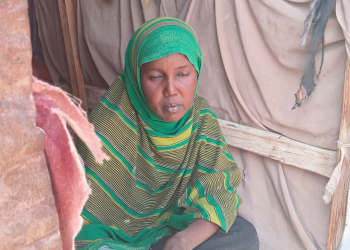


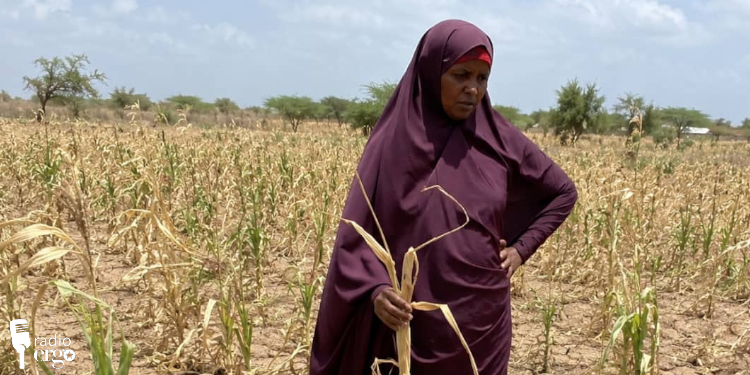
(ERGO) – Farhiya Abdullahi Abdi, a farmer in southern Somalia’s agricultural breadbasket, Lower Shabelle region, has lost all the crops she expected to harvest recently due to water shortage, leaving her family in crisis.
With a household of 13, Farhiya said all the vegetables and other crops she expected to harvest on her farm near Afgoye in early August were wiped out. She had spent heavily on seeds, irrigation and farm preparation in Marerey village. But now, she is unable to plant again as the water shortage continues and she is financially broke.
“The biggest challenge is the water shortage, which has destroyed all our crops,” she said. “The river has run dry and there are no wells here. We planted the crops in May, but they have not been ready for harvest as expected.”
Scores of farmers in Marerey, Jambalul and Shukurow villages, northeast of Afgoye, are facing similar hardship after their crops failed due to lack of river water.
Farhiya said the family was struggling to obtain food and water. She sometimes gets food on credit from shops, and relatives give her the occasional dollar. A 20-litre container of water costs $0.25, which she cannot afford so she relies on small amounts of water from neighbours.
Four of her children have stopped attending their Koranic school after she failed to pay the $5 monthly fee for the past three months.
She is being pursued for repayment of the $500 she borrowed for the farm and owes a further $180 for food, water and other bought on credit for her children.
“I had hoped the farm would support my family and allow me to continue farming, but I lost everything I invested and am now left with debts and no means to support my children or plant another crop,” she said.
Having farmed all her life, she has no other skills to earn an income and is struggling to cope.
The water shortage is affecting many other farmers along the Shabelle river, while rising fuel costs are making irrigation unaffordable and reducing agricultural production.
Another farmer, Mohamed Hassan Omar, said he lost all the crops he planted on his three-hectare farm in May, including maize, sorghum, beans, tomatoes, cucumbers and other vegetables. He had taken loans for the farm investment, hoping to make a decent profit to support his family and repay his debts.
“We have been badly affected by the crop failure caused by the lack of irrigation, as the river has run dry,” he said. “I lost about $900 invested in the farm and have no other source of income. The crops and vegetables dried up, leaving us with nothing to eat or sell.”
The family of 16 are struggling to obtain food and water. They get water on credit from a private well, where a container costs $0.25. They cook one meal a day, eking out the 20 kilograms of food he borrowed in early August. He owes $70 for this food, in addition to $200 he already owed.
He looked for farm labour work in other areas but couldn’t find any. Some days, the family cannot cook a meal, with his young children particularly affected.
“Life has become very difficult for our family. We depended on the farms for our livelihood, but we have lost the benefits they provided. I have been unable to provide my children with enough water, food and
education,” he said. “We are facing severe financial hardship, and everything we depended on for our livelihood has been lost.”
Eight of Mohamed’s children dropped out of Koranic school in July as he couldn’t pay their combined monthly fee of $40. He is distressed by their lack of education but has no solution.
His financial difficulties have also affected his sister and her five children, as he can’t pay her the $50 and food he used to provide them each month. They are resorting to begging.
Mohamed’s family has lived in Shukurow for generations and depended for more than 20 years on the farm he inherited from his father. He said the crop losses have ruined them.
The chairman of the local Dan-wadaag Farmers’ Cooperative, Abdi Mohamed Abdullahi, said they needed joint efforts to restore the neglected irrigation canals.
“The water shortage has become increasingly severe, while the high cost of fuel has made it difficult to afford irrigation for the farms,” he said. “As a result, the income generated from agricultural production has declined”.
The farmers’ cooperative is seeking solutions for a reliable supply of irrigation water, but they need support in the form of equipment and technical expertise.
Abdi said the irrigation problems had persisted for a long time but had now reached their worst level due to declining river water levels, neglected canals and farmers’ financial difficulties.
The cooperative has requested assistance from local authorities and aid agencies but has had no response.