

(ERGO) – Hundreds of men in the mountainous areas of Somaliland’s Sanag region are turning to artisanal gold mining as a means of survival, after being displaced by conflict or pushed into poverty by drought.
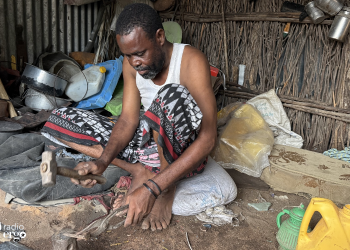
Abdisalan Ahmed Abdi, a former teacher, heads out each day with basic tools to mining sites not far from his home in Milho, returning with income that has significantly improved his family’s living conditions.
He earns at least $15 a day to cover food, water, electricity, and other essentials for his wife and eight children.
“The work has changed my life. I was living in a rented house and was constantly worried for my family. Now I have built my own home, I pay for schooling, and I can meet all our needs. I hope to achieve even more and start other businesses,” he said.
Abdisalan arrived in the area with nothing after fleeing violence in Erigabo in 2024. He has since managed to save around $20,000 after finding and selling gold deposits. He built a two-room corrugated iron house on the outskirts of the town, becoming one of the more stable residents in the community.
He attributes his progress to persistence despite the demanding nature of the work.
“Gold mining is very hard. The place is extremely hot, and the pits are deep. Sometimes it becomes difficult to breathe. It depends on luck – two people can work in the same place, and one may find gold while the other finds nothing.”
In recent weeks, his findings have declined due to rainwater flooding the pits. Global factors, including conflict in the Middle East, have affected gold prices, with a gram of gold that previously sold for over $120 now fetching $90-$100.
Most miners in the area extract gold from shallow depths of one to two metres, while others dig as deep as 100 metres underground despite the significant risks.
“The deeper pits are the most dangerous and we lack proper equipment. Hiring machinery is expensive, and we don’t have tools to detect where gold is. But buyers have slowed down due to the situation in the markets,” he told Radio Ergo.
Abdisalan began mining without any training after failing to find work as a teacher. Others who lost livestock due to drought have also joined, like Ibrahim Mohamed Abdi, a former pastoralist.
He lost 160 goats due to water shortages and lack of grazing. Encouraged by others, he started mining late last year and now spends long hours, often overnight, in the pits making around $10 a day to support his family of eight.
“This work has improved our lives,” he said. “We are no longer begging. I can pay rent, send my children to school, and provide for my family.”
However, the work is labour-intensive and requires multiple steps. Soil is collected, transported to water sources, and washed repeatedly to separate any traces of gold from other residue.
Ibrahim relies on simple, traditional tools that limit his productivity. More advanced imported equipment costing over $3,000 is in use by others. He hopes to acquire essential gear, including breathing equipment to make working in deep pits safer.
“The danger is everywhere. Rocks can fall on you, insects bite, and the pits can collapse. Sometimes you can’t breathe. It is very dangerous work,” he said.
Still, the work has allowed him to rent a two-room house for $80 a month and support three of his children in school.
Local leaders say the influx of people into gold mining reflects broader economic pressures across the region.
The chairman of one of the local mining companies, Mohamed Garaad, said many of those joining the sector are displaced people, former pastoralists who lost their livestock, or fishermen who abandoned coastal livelihoods due to attacks and overfishing by illegal foreign trawlers.
“Anyone can come and mine here,” he said. “There are no restrictions. But the increasing number of people has made the work harder, as miners are forced to dig deeper and deeper.”
He highlighted poor infrastructure as a major challenge, noting that roads connecting the mining areas to Milho were in poor condition, making it difficult to transport equipment and supplies.
“Even bringing in tools is a challenge,” he said. “Most equipment has to be imported, often from China, which increases costs.”
Safety is another growing concern. In the past three months, one miner has died and 10 others have been injured after pits collapsed during excavation. Many of the new arrivals lack the skills needed for safe mining, increasing the likelihood of accidents.
“These are people pushed into this work by hardship,” he said. “They don’t have training, but they have no other options.”
Local leaders say gold mining could develop to provide sustainable livelihoods, particularly for young people, if it is supported with investment, training, and modern equipment.