

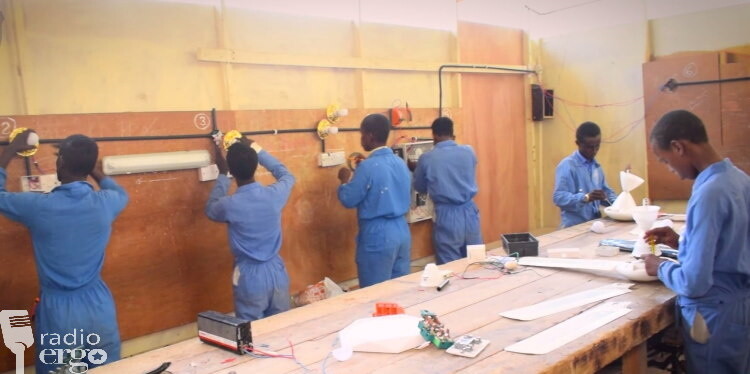
(ERGO) – Young people living in Mogadishu’s displacement camps complain that they are trapped in unemployment because they can’t afford the cost of training in marketable skills that could get them a job.
Ahmed Ali Hassan, 19, knocked on the doors of six different workplaces in as many months looking for a job, only to be turned away each time.
As the eldest child and sole provider for his family of six, including his mother and four siblings, Ahmed carries the weight of their survival on his shoulders.
Even securing one meal a day is a challenge. At night, Ahmed listens to his younger siblings crying from hunger.
“My dream of leaving displacement has ended,” he said. “I wanted to train as an electrician, but I could not pay the $35 minimum fee they demand at school. My ambition has been destroyed.”
Ahmed’s family have been living in Daryel camp in the city’s Kahda district since 2021. That year, his mother was diagnosed with diabetes and couldn’t continue the cleaning jobs that once supported their daily needs.
Since then, Ahmed has tried to support the family by selling small items on the streets, earning no more than 40,000 Somali shillings a night (less than $2). He spends $20 each month on his mother’s medicine, leaving little for food and water.
Ahmed, whose father when he was a child, says he has been struggling alone to support his family since he was 15.
His hope of becoming an electrical engineer was shattered four years ago when floods from the river Shabelle destroyed their home and farm in Jowhar, Middle Shabelle region, forcing the family into Mogadishu’s IDP camps.
Many youth in the camps aspire to learn trades in electricity, phone repair, computers, or tailoring, seeing them as the path out of poverty, but the opportunities remain out of reach.
Abdikadir Ibrahim Yusuf, 20, living in El-Qalow camp on the outskirts of Mogadishu, says five years of displacement have left him with no way forward. His family, fully dependent on him, lives a precarious daily existence.
“My main obstacle is poverty. My family depends on me. They couldn’t pay for my schooling before, and now they can’t afford vocational training. We are displaced people. Some days we get one meal and sometimes we don’t get any, we are just surviving that way,” he told Radio Ergo.
The family can’t afford to buy the minimum 20 litres of water they need a day as the private well two kilometres away charges 3,000 shillings per jerrycan. They rely on begging for water and don’t always get any.
Abdikadir has long dreamed of becoming a carpenter, skilled in making household furniture. However, when he went to register at a carpentry centre recently he was asked to pay $25 — more than his family earns in a month.
Discrimination has also barred him from jobs. Employers in Mogadishu told him they could not trust him because he is displaced. He now works at a kiosk selling drinks, earning $1 a day, barely enough for a single meal for his family of four.
The family lives in a shack, patched with an old tent and pieces of cloth. At night, they fear thieves who regularly raid the camp. In August, armed men tried to enter their hut but fled when neighbours rushed to help.
Abdikadir’s father was killed in clashes in Qoryoley district in 2020. The family also lost 80 goats and their three-hectare farm due to combined conflict and drought, pushing them into displacement.
In a survey conducted in June, the local education group, Bar, documented 400 displaced parents in Mogadishu who couldn’t afford vocational training for their children.
The organisation’s deputy chairperson, Mahamud Guled Absiye, said their efforts to lobby companies to train or employ displaced youth were rejected.
“Young people in displacement face many challenges. They are often denied casual jobs because of discrimination against displaced people. We approached companies to persuade them to train or employ displaced youth, but they refused. Now is the time to support these young people so they can pull their families out of displacement,” he said.
Mahamud added that they had been able to link only 40 young people to vocational training centres, a very small number compared to the scale of need.
In the camps, some primary schools offer opportunities to children under the age of 10. But older children mostly have no access to continue their education or to start vocational training.