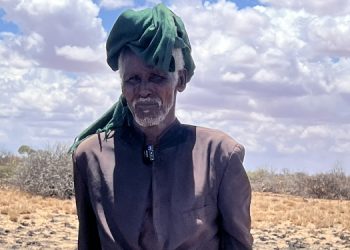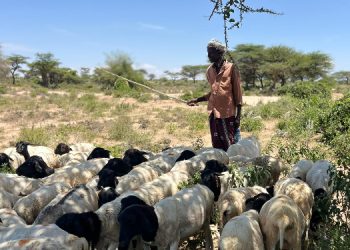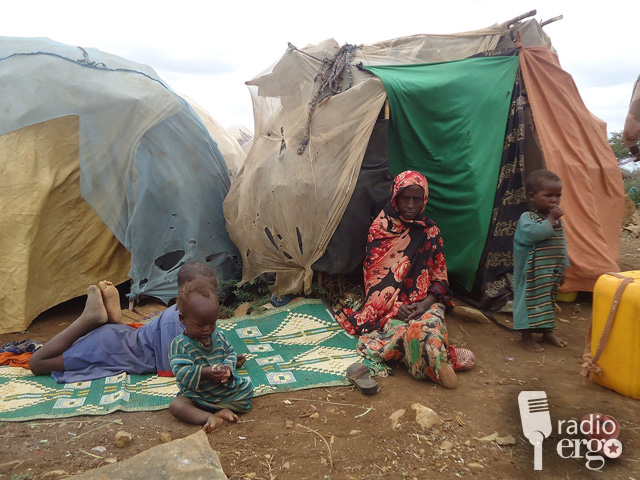
Hundreds of families who fled devastating floods in Ilmo-adeer village, in Puntland’s Garowe district, in April are camping on higher ground outside the village without enough food, clean water or proper shelter.
No aid has reached them since the floods swept away their homes, shops, farmland and livestock, leaving them destitute. Many are now burdened with heavy debts, unsure how they will rebuild their lives.
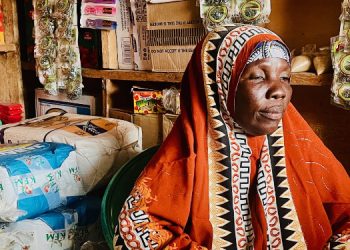
Among them is Warda Osman Ali, living with her husband and seven children. Once the owner of a grocery shop and a stone house, she says her family has been reduced to begging. They survive only on small handouts of one or two dollars at a time, sent by her friends and relatives in Bosaso.
“We can’t manage three meals a day. Sometimes we find just one, whether lunch, breakfast or dinner. The rest of the time we go without. My husband has no work; he just sits idle. We can only hope for God’s help to open a way for us,” Warda told Radio Ergo.
Her children have been suffering from repeated flu and fever, but she has no money for basic painkillers, since the floods destroyed the local health post.
At night, the family squeeze together in a makeshift shelter built from scraps of corrugated iron and wood salvaged from the floodwaters. During the day they huddle under trees with little protection from seasonal winds.
Warda recalled the night when flash floods tore into her stone house, collapsing two rooms, a kitchen and a toilet. She lost her small shop as well, with goods valued at around $2,000 washed away.
With it went her modest income of $15–20 a day, which had been just enough to cover her family’s needs.
“My business collapsed completely. I had a shop that supported us. The floods washed everything away, even our house. On top of that, I owe $3,800 in debt from stock I had bought, and I have no idea how I can ever repay it,” she said.
The family’s two older children have dropped out of school, as she cannot afford the $7 monthly fee for each child. Warda says she sees no chance of restoring her business or her children’s education.
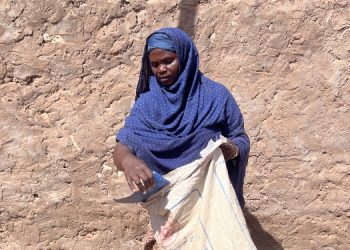
Fadumo Abdi Hassan, another mother among the displaced, has been struggling to raise her five children alone since the floods destroyed both her home and the small stall where she sold groceries and tea.
“I lost my house and my stall where I sold goods. We lived near the road and the water inundated us. We didn’t have much to start with – just that small income that we relied on. Now it’s all gone, taken by the water,” she said.
Fetching water has become her greatest burden. She collects a single jerrycan a day from a private hand-dug well in Khayrsame village, seven km away, after pleading with the owner. A barrel of clean water delivered by donkey cart sellers costs $15 – far beyond her means. Her children drink the brackish water she brings, which she says has already caused stomach problems.
Fadumo estimated she lost $3,000 in goods swept away by the floods. She has $500 in debts, and her creditors have warned they will take action if she cannot repay within three months.
Her children’s schooling has also ended. The two in primary classes had to drop out when the school in Ilmo-adeer was destroyed in the floods.
Separated from her husband two years ago, Fadumo says she feels overwhelmed and hopeless about her children’s future.
Ilmo-adeer village chief, Mahamud Bile Omar, told Radio Ergo there were warnings of potential flooding in a report in 2022, recommending relocation as the land was deteriorating.
“FAO mapped the area with GPS and told us that within four years the village should be moved, as natural erosion and collapse were underway. Resettlement was discussed, but nothing has been implemented,” the chief said.
Some families have returned to their damaged houses, now standing on cracked, unstable ground, because they had no other option.
Geologist Kaafi Abdi Aden explained that repeated floods in Ilmo-adeer are linked to environmental degradation.
“The vegetation has thinned, the land has weakened, and the village lies on a flood route. The water channels need to be diverted using stone and metal barriers that can hold the water while allowing it to seep underground. Long-term reforestation is also critical for a sustainable solution,” he said.
Ilmo-adeer has existed for at least 40 years, but in the past three years hundreds of families have been forced out by recurrent flooding.