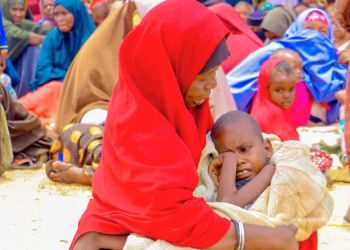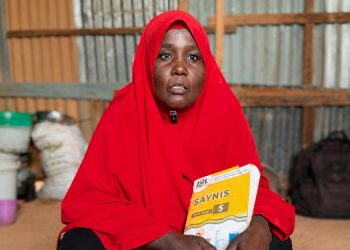


(ERGO) – In the two years that she has lived in Dadaab refugee camps, Halimo Ali Mohamed had been managing to support her family of 10 children by doing laundry work for better off refugee families in Ifo camp.
But the downturn in the camp economy caused by dramatic aid cuts and fewer jobs and activity has meant that nobody can afford to hire female domestic workers like Halimo.
She used to find work three or four days a week, earning up to 10,000 Kenyan shillings a month ($77), that was enough to buy 20 kilos of flour, rice, and sugar to top up the food rations from aid agencies, and also to cover school and household costs.
Despite walking every morning for four hours from where she stays to Ifo 1 camp to look for work, she has found only five days of aid work in two months, making just 300 shillings ($2) each time.
“I have nothing to provide meals for my children. I can’t even make tea. Life has become so much harder than before,” she said. “There is nothing in my house, as you can see, and no relatives or family to fall back on. I am a mother with small children who has no food – nothing is heavier than that.”
The last food aid she received was at the start of August – 30 kilos of rice, seven kilos of maize, and five litres of oil. It was supposed to last until mid-October, but it ran out on 17 September.
“When I had work, I could buy vegetables and bring home something extra with the little I earned. Now, when I come back, the house is empty, just as I left it in the morning. I am overwhelmed by sadness. Sometimes after three or four days someone gives me a kilo of flour or maize meal, but that is all,” she said.
Halimo has debts of 25,000 shillings and says people don’t trust to lend her any more knowing she has no income. Her husband lost his construction job at the start of the year and returned to Somalia in June in search of work, but has not been able to support the family.
She and her family joined the refugee camps in Kenya in 2023 after fleeing drought and conflict in Qoryoley, in southern Somalia’s Lower Shabelle region. They lost 30 cows to drought and were unable to harvest their 10 hectares of farmland.
Another refugee, Deran Aden Hussein, walks six kilometres to Ifo 1 camp to ask households for work. She invariably returns exhausted and empty-handed.
“Every day I leave my house and come back with nothing. I knock on doors, I ask for work. Sometimes God helps me, sometimes not. I never rest,” she told Radio Ergo.
Deran supports her nine children alone after her husband went back to Somalia. She used to supplement her food aid ration and monthly cash of 5,740 shillings with small earnings from cleaning jobs. Now, the cash aid has been cut and she can’t get any jobs in the camp. They are eating only one meal a day.
“Before, I could cook for the children three times a day. Now there is nothing. No food, no clothes, not even shoes for them,” she said.
The borehole her family relied on broke down early this year and has not been repaired. She carries 40 litres of water on her back from a well five kilometres away, before setting out to look for work every morning. The sandy terrain and heavy load have given her back pain that stops her sleeping.
More than 1,500 families who also depended on this broken borehole in Ifo 2 are facing similar shortages.
Two of Deran’s children were expelled from Koranic school this month after she failed to pay 800 shillings in fees for four months and she worries about their education.
Cuts in refugee rations meant that in August, Deran received only 50 kilos of rice and maize and eight litres of oil, compared to 90 kilos of grain and 16–18 litres of oil previously.
The chairman of Ifo 2 camp, Khayro Ali Soya’an, said unemployment had darkened the lives of many families. Most refugees in Ifo 2 are rural people with no skills or education to fall back on.
He said at least 200 women, often sole providers for their families, were affected in the same way as Deran and Halimo.
“People here can’t support one another – most are jobless and have nothing. Before, the women earned by washing clothes, but now even that is gone. Life is very harsh, and many households are struggling even to light a fire for cooking,” Khayro said.