

(ERGO) – The closure due to funding cuts of 11 health centres in Baidoa have left hundreds of displaced and impoverished Somali families unable to access free health care.
Awliyo Warsame Mohamed, 38, expressed her despair over the closure of the health centre in Qaydar-cadde camp, where she and her son had been receiving free medical care three times a week. The facility provided essential medicines, nutritional supplements and biscuits, and maternity services for pregnant women, and child vaccinations.
“Since this centre was closed, we have suffered greatly from the loss of medicines and the Plumpy’nut given to children. Even the biscuits were a lifeline, and we struggled without them. One of my children developed an ear infection with constant discharge and severe pain, but I couldn’t get the treatment he needed. It’s been very difficult,” she said.
Awliyo, a mother of seven, said for two years they had relied on the clinic for their healthcare, but now she has no option but to walk five kilometres into Baidoa town to seek medicine on credit from pharmacies. She has already accumulated $20 in debt trying to treat her children, and worries constantly about their health and survival.
“The burden I feel is immense. The medicine has run out and even simple injections are unavailable. I cannot afford a tuk-tuk ride, so I walk into town. Sometimes, I stand outside the closed health centre until midday prayers, still hoping for help,” she explained.

Awliyo said she is the family’s sole breadwinner, as her elderly husband is too weak to work. She earns less than a dollar on the days she finds casual jobs, barely enough to buy one inadequate meal for the household.
None of her children are in school due to the family’s financial struggles. They were displaced in 2023 from Ruwey-gadud, 30 kilometres from Baidoa, after drought wiped out their small herd of livestock.
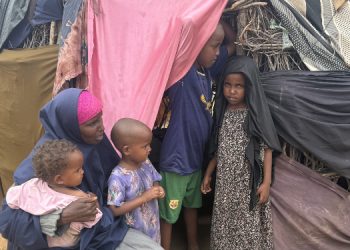
Another mother, Marin Abdullahi Madker, 43, with 10 children, also relied heavily on the Qaydar-cadde clinic. She and her two-year-old son used to receive weekly treatment and nutritional support there. The closure in February came as she was still recovering from postnatal complications after giving birth. Her son was also malnourished and had been receiving Plumpy’nut and other supplements at the clinic.
“Every morning I still go to the closed health centre, holding onto hope that it will reopen. It was vital for us. We could get everything there without having to travel far for healthcare,” Marin said.
She added that her family was now in a desperate situation, depending on cooked food shared by neighbours, which was rarely enough for everyone.
At times, the children go to bed hungry when no food is available. The family fetches water from a well 30 minutes away, carrying it home on their backs. A single jerrycan costs 1,000 Somali shillings.
“There are no free wells anymore. If you don’t have money, your jerrycan will not be filled. Even paying 3,000 or 4,000 shillings is sometimes not enough – they demand more. Without cash, you get nothing,” she said.
Marin’s family was displaced in 2023 from Busley in Bay region, after drought destroyed their five-hectare farm.
The health centres had been managed by the local Deeg-roor Medical Organisation (DMO), which reported a sharp decline in funding from agencies including USAID and UNHCR.
Dr Mustaf Hassan Mohamed, from DMO’s management team, said the financial shortfalls set in in February, leading to the complete closure of 11 centres. Seven other centres run by DMO remained operational under severely limited conditions.
He explained that the few remaining staff were working voluntarily. Many staff had been laid off and there were acute shortages of staff and supplies. The centres, once supported by agencies such as Health International, were located in Baidoa town, in displacement camps, and in villages including Awdinle, Goof Gadud and Burey.
“The worst impact has fallen on the people who depended on these facilities as their only source of healthcare. Many young staff were also dismissed when donors announced they could no longer sustain funding. Out of 18 centres we once operated- some fixed, some mobile – only six are still functioning.
The outlook is bleak if urgent support is not secured, because we cannot meet the needs without resources,” he warned.
He cautioned that other remaining facilities in Awdinle, Goof Gadud, and Burey were also at risk of imminent complete closure.
For thousands of displaced and poor families, the free health centres were lifelines. Their restoration would offer critical relief and ease the daily hardships of communities already struggling with displacement, hunger, and poverty.