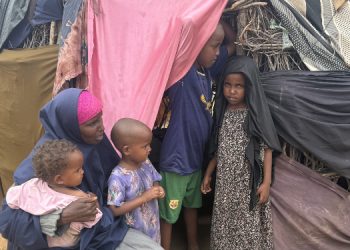


(ERGO ) – Forty-year-old Maryan Muse Magoye is caring for 28 children – 10 of her own, and 18 of close relatives – without an income or stable living conditions in a displacement camp in Mogadishu.
Her struggles illustrate the vulnerability of people living in the city without jobs or support services, amid the pressures falling especially on women by increasing numbers of broken families.
Her household in Koris camp in Deynile district more than doubled in February, when 18 children were dumped on her, including the children of her daughter who divorced, those of her brother who separated from his wife, and the children of her deceased sister whose husband was also killed.
“The family’s living conditions are very poor. The children you see don’t have a single consistent meal. It is difficult to get that one meal. Sometimes I take food on credit from a shop. I see the shopkeeper sometimes tell me, you still owe the money you took yesterday, I can’t add to it today. If I insist and say that these orphans need it, they give me the items,” she said.
“I have cried on social media for the sake of these children who have nothing.”
Maryan has shared her contact number on social media, appealing to well-wishers for charitable donations. The large family requires at least five kgs of food per day, and the amounts of donations she receives don’t cater for their needs.
“I am on the verge of talking to myself, and I also have diabetes. Our situation gets worse every day. I am asking my Somali brothers and sisters to support me. Allah said, ‘I will help the one who helps an orphan’. I am asking my brothers and sisters at home and abroad to give me encouragement, whether it’s for shelter, setting up a shop, or helping me with their daily lives,” she told Radio Ergo’s local reporter.
Maryan’s husband has been at home without work digging wells as he used to because of a nerve condition paralysing his leg and arm, and high blood pressure. He’s also become dependent on his wife for care, adding more pressure on her. She can’t afford to take him to a hospital nor to provide him with adequate nutrition.
For more than 20 years, Maryan earned a decent living of up to $200 a month making clay charcoal stoves. However, the market for these stoves has gradually dried up, as many people have switched to using gas and durable iron stoves that don’t burn charcoal and wood.
“This work has stopped one hundred per cent. No one cares about it, no one needs it. Everyone mostly uses SOMGAS. When these stoves sold well, my children’s daily life was fine. I used to earn seven to eight dollars a day in the market. I used to buy their rice, pasta, and meat from that, and their bread,” she said.
With no work since March, she still owes $300 to the people she sourced the clay from, at a location outside Mogadishu.
Most of the children she is caring for have reached school age, but financial hardship prevents them from starting formal education. Maryan currently sends 12 of the children to learn the Koran for $36 a month, a payment she is not always able to make.
“I can’t afford school. Sometimes the monthly fee is paid, sometimes it isn’t. The teacher is patient with us, and we pay him when we can. This girl you see here is an orphan; it’s her time to be educated as well as the others you see. School fees are five dollars per child, and I can’t afford it,” she said.
Maryan’s family moved to Koris camp in Deynile district in January, after landowners evicted them during the night from Iga Horkeen camp where they had been living in Garasbalay district.
Koris is home to nearly 300 families. The land is owned by local people and the camp dwellers have no contract or guarantee of tenure. They are able to live rent free, but there are no basic services like a school, water, or a health facility.
“Someone just told us that we could settle on this land until they need it. It’s an act of human kindness. When they need it, they will tell us to leave, and we will,” she said.
“One day we will have to leave. I am always being told to get up and move. I don’t own land, and I don’t have the money to buy it to provide for these orphans.”
Maryan’s own family have been evicted from four camps in Kahda and Garasbaley districts over five years, since leaving their farming livelihood in Marka, Lower Shabelle region, due to insecurity.