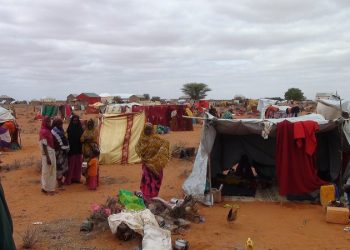


(ERGO) – Nearly 600 families living for years in displacement camps in the southern Somali town of Baidoa have been moving out of ramshackle huts and into newly built houses, under a joint programme by the local administration with UN and non-governmental agencies.
Adan Sheikh Isaq’s family’s family exchanged their makeshift hut in Turqow camp for a two-room house in the new settlement of Barwaqo in March.
“It’s like living inside now after having slept outside, it’s such a change. We used to have no protection from the sun or rain,” he said. “We have left out huts behind now and life is much better!”
As part of the programme, Adan, 53, also received $300 funding from IOM to start a small shop selling food and vegetables.
“I earn between $5 and $6 a day. That’s our main income now. Before, we had nothing to cook. We begged and waited for occasional aid. Now, we can cook twice a day, morning and evening,” he said.
With seven children, he had struggled to find work for a year. Four of his children, two girls and two boys, now go to Barwaqo’s free primary and secondary Barwaqo Two School, built by international NGO, Save the Children. It’s their first time in education.
“Life is good and the difficult times are behind us. I’m no longer a displaced person, I’m one of the city residents,” Adan told Radio Ergo.
The houses built by UNHCR are made of corrugated iron sheets and bricks, each on a 250-square-metre plot. Piped water is being installed by the Ministry of Energy and Water of South West State. Until the taps are open with free water, people have to walk five kilometres to fetch water from a well.
Free electricity from 6pm is another benefit in Barwaqo. Those interviewed by Radio Ergo said they no longer feared the dark.
Another satisfied occupant of a new house is Mahamed Hasan Mursal, 52, a father of 13. With his $300 investment he also set up a shop selling clothes and food and vegetables. It makes about $4-$5 a day that covers basic household needs.
“I never expected to be independent again. Now, I’m a settled man and my family is settled in a house – with a door that shuts!” Mahamed said.
Living in Mugey Aarow camp, none of his six school-age children had been able to go to school but now they have started their education.
“This is the first real aid we’ve received since leaving Abal village in Bakool region,” he said. “Drought destroyed my three-hectare farm. We arrived here with nothing. Now, we have shelter, food, education, and health care.
“I used to worry all the time, but now I can get credit when I need something. I am no longer a displaced person.”
Halimo Ibrahim Hasan, 41, is living in a new two-room house with her husband and 11 children. They had been evicted from four different camps and were thankful to be selected for the resettlement programme.
“I never thought I would receive such shelter,” she said. “We used to live under the open sky. Poor housing was our biggest challenge.”
She used to make one or two dollars doing odd laundry work. Now, she runs a small business with the support she received from the programme and is saving $2 a day.
“I saved $120 in two months – 60 each month,” she said proudly. “I deposit it because if I keep it at home, the children might take it.”
Her savings cover school supplies, clothing, and emergencies. Six of her children now attend school nearby for the first time
“If your children sit at home with no education, it’s very hard. Now they are learning and their health is taken care of.”
Halimo’s family escaped conflict in Beled-Hawo district, Gedo region, in 2023, and came to the displacement camps in Baidoa with nothing. She used to run a restaurant in their village that supported her family.
“I had to start from zero,” she said. “Now, I am settled. When I compare life then with today it’s like night and day.”
The South West state administration, in partnership with Norwegian Refugee Council and UN agencies IOM and UNHCR, launched the resettlement initiative to help families escape the cycle of displacement. Those selected were chosen based on factors including vulnerability and length of time in the camps.