

Farmers in north-eastern Kenya’s Mandera county say they need help to recover from recent river flooding that destroyed their crops and left them without any income.
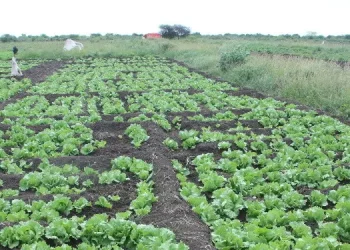
Around 150 farms in Bela, Mata-Safa, and Qalaliyow in Mandera were inundated by the river Dawa in April. Flood water still stands across many of the fields.
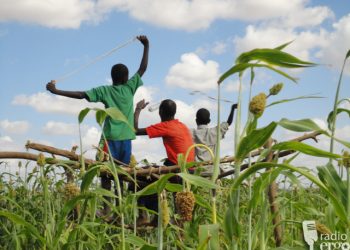
The river Dawa forms the borderline between Kenya, Somalia, and Ethiopia. This part of Mandera normally produces a variety of crops including vegetables, fruit, maize, sorghum, beans, and sesame.
Kali Mahamed Hasan, a local farmer, told Radio Ergo that her family’s only source of income was their farm. But flooding on 15 April swept through their fields before they could harvest anything.
“The farm the family depended on has been destroyed and we are now reduced to doing manual labour, trying to get by,” she said.
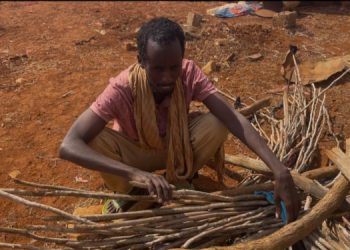
“Sometimes I earn 500 Kenyan Shillings [less than $4] on a construction job but then I don’t find work for a month. Sometimes I work two or three weeks and only get one or two days of pay. We live day to day and rely on God, not plans. We are suffering greatly and some days we have lunch and other days we eat nothing.”
Kali, 55, a mother of 10, described how the floods destroyed all the maize, beans and sesame they had planted on their four-hectare farm, as well as 153 fruit trees, including mango, lemon, and papaya. They also grew like bell peppers, spinach, cabbage, and tomatoes.
They had taken over $2,300 in loans for the farm.
“We were hardworking people. We supported our families and children through farming. But now, everything is lost. I have no savings. I never worked for the government or had a salary. We are poor people who lived off our farms and now there is nothing,” she said.
Kali’s husband is disabled and unable to work. Five of her children attend government-run schools, but with no income and no harvest, food is scarce.
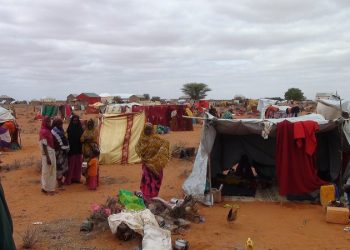
As the land is still soaked in floodwater, planting for the next season is not possible. The floods in April were the third major floods to occur in two years.
Deqow Mahamed Hasan also lost everything and his farm is still under water, leaving no chance for recovery.
“I am empty-handed,” he said. “I invested everything I had. Now I can’t harvest anything.”
He has accumulated $250 in debts for food from a local shop and can’t get any further credit unless he pays this off by early June.
He estimated his total losses at 2.5 million Kenyan Shillings [nearly $20,000] for machinery, seeds, fertiliser, water storage tanks, and workers’ wages.
“I bought a pump for 180,000 shillings. I borrowed 700,000 for fertilisers, I bought seeds, fuel, and supplies. I used to feed my workers from the shop – all of this adds up,” he said.
“I have no property to sell and no relative who can help. As the saying goes, I’m waiting for no one. No well is dug for me. I have no one but God.”
Deqow, 48, said the floods destroyed nearly 400 mango, lemon, and papaya trees. He employed six workers on his farm and now struggles to feed his 10 children.
“When you have a small child and tell them to sleep without food, they won’t understand. They think you’re hiding something. This situation is causing me great worry. A man recently asked why I’ve become so thin and I told him it’s sorrow, I am very, very sad.”
He now spends nights at the mosque, praying for relief.
The chairman of the local farmers’ cooperative, Hussein Ali Mahamed, described the situation as a disaster beyond their control.
“This is not something we can fix. We have no support from the [Kenyan] government or aid organisations. We talked to officials but no action has been taken.”
He said they had tried to barricade openings in the river banks to prevent the flooding but whatever barriers they built were swept away.
On past experience he thinks it may take up to four months for the water to recede, leaving the local farming families with no income in the meantime.
“We need immediate food aid. We need equipment and vehicles to shore up the river banks to stop the water from reaching us.”
Jobs for the hundreds of wage earners who normally work on the farms in Bela, Mata-Safa, and Qalaliyow are also gone for the time being.