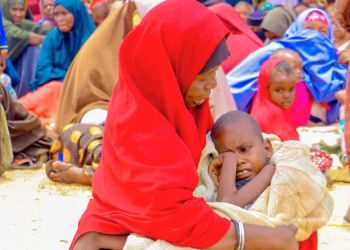


(ERGO) – Families living in displacement camps in Baidoa, southern Somalia, are rebuilding their lives through small businesses funded by accessible bank loans, enabling them to escape food shortages and return their children to school.
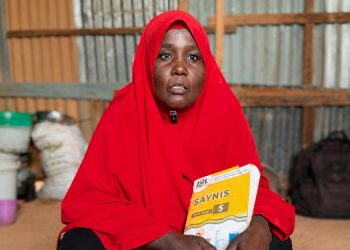
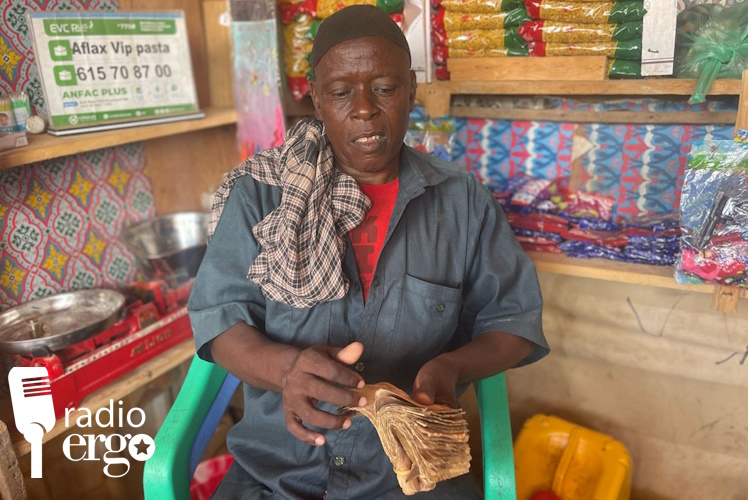
Among them is Ajrimo Adan Hasan, a 45-year-old mother raising 10 children on her own. She started a small shop selling food and vegetables in December after taking a small loan of $1,000 from a local bank.
The business has done well and Ajrimo has already paid back to the bank, from the profits of $10 to $17 a day she makes from her shop. In February, five of her children began attending Al-Macruuf School, where she pays $25 monthly fees. She also pays for water more regularly, which costs 25 cents per 20-litre jerrycan.
“I have food now, praise be to Allah, we are enjoying ourselves and it’s good for us. This life is better than before. My children used to lack clothes but now we can buy them. We cook three times a day although we used to cook just once. If we found bread in the morning, that was all. The rest of the day, the children went hungry,” Ajrimo said.
The family was displaced in 2022 from Bardere district in Gedo region, where they had a five-hectare farm that failed due to drought. Ajrimo’s husband died in a bomb blast in Baidoa in 2023, leaving her as the family’s sole provider. For months, she survived by begging and walking five kilometres to gather wood to sell.
“I used to sell firewood for 2,000 shillings worth of bread. Carrying firewood from the bush was hard work and it didn’t sell well as I didn’t know the town well and struggled a lot,” said Ajrimo, who plans to move out of Adable Adow IDP camp into town now that she is earning well.
Ajrimo said she hadn’t considered starting a business until neighbours encouraged her. At first she doubted that she would be able to qualify for a bank loan due to the requirements of having a guarantor with at least as much cash reserve or other property as the value of the loan.
“The bank told me they don’t trust rural people,” she said. “They asked if the mother dies, doesn’t pay, or disappears, who would they be able to go to [for the money back]? One of my relatives said I could approach him and he guaranteed me.”
Mahamud Ali Husein, a father of seven, also took a bank loan to start a grocery shop in Baidoa that enabled him to move out of Bula Habib camp in January.
He had lived in the camp since being displaced in 2022 from Tiyeglow in Bakool region by drought and an Al-Shabaab blockade that cut off trade and supplies. He is now renting two rooms in the city for $40 a month, with water and electricity included.
“I manage many things with this business, including the children’s food. I sell sugar, rice, and other groceries. Life is very good now,” he told Radio Ergo.
He had been doing casual construction labour earning $3 to $4 a day once or twice a week. Now he is making $18 to $20 daily, enough to pay school fees of $20 a month to send four of his children to school.
“Our previous life was very poor. I had nothing. One day we had food, the next we didn’t. It was unpredictable,” he said. “This kind of income is new to me and I am very hopeful. I’m praying for even better days ahead.”
Mahamud has already repaid his full $1,000 loan back to International Bank of Somalia (IBS). He has also saved up $300 towards his dream of buying land and building a permanent house. He is thankful to the camp chairman for helping him by acting as guarantor for his loan.
Mother of nine, Gudey Abdullahi Macallin, 38, opened a grocery shop in Bula Gedisoy camp three months ago with the loan she took. She has already paid back $600 from her profits.
“Before, we only cooked once a day. If we didn’t find food, that was it – there was no solution. Our situation was very bad,” she said.
This year, she started paying $30 a month for six of her children to start school. Her elderly husband, aged 70, can’t work. Gudey had been making just one or two dollars doing laundry.
“I used to ask myself where I would find food for these children. I worried constantly. Now, that worry has gone, thank God. We used to depend on neighbours for drinking and cooking water, but since December, that struggle is over,” she said.
Her family left their three-hectare farm in Jawarey, Bay region, in 2023 due to drought. She hopes to move out of the camp to Baidoa town.
“My ambition is for this business to grow to keep paying off what I owe, to keep trading and to build a life beyond the camp,” Gudey said.
Radio Ergo found 81 displaced families, formerly farmers or pastoralists, who had taken microfinancing to open grocery shops, vegetable stalls, and small eateries that now provide steady income.