

(ERGO) – Subiya Sheikh Yusuf and her six children have been left with nothing after being forcibly evicted from Fililbin camp in Garasbaley district of the Somali capital, Mogadishu, on 25 February 2025.
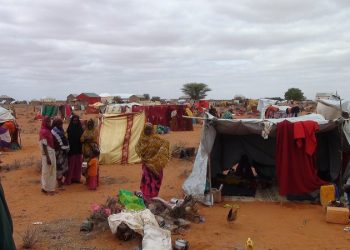
They are now short of food and water, and are homeless – camping in an open area on the outskirts of Mogadishu.
Subiya’s family is among 215 IDP families evicted from the camp, all of whom are now facing extreme hardship. Since they have nowhere else to go, she and her children have temporarily sought shelter under a tree.
“At the previous camp, we had people who knew us and helped us. We used to sell various items like tomatoes and candy to survive. But now, everything we had is gone. We are living in misery,” she told Radio Ergo’s local reporter.
Subiya lost her $200 savings that she had invested in the fresh vegetables and other merchandise she sold from a table stall. A well-wisher had helped her start this small business in the camp..
That business was the family’s only source of income, allowing her to earn $2 to $3 per day, which was enough to feed her children twice daily.
In the camp, they had easy access to water, but in their new location water is scarce and costly.
“Now, a single jerry can of water costs 3,000 shillings. If someone cannot afford it, others might help them fetch water. Before we had water freely available. Now we have no home – you can see for yourself,” she told our reporter.
Subiya’s family was originally displaced from Qoryoley district in Lower Shabelle region in 2023. Clan conflicts in the area led to the killing of her husband, the sole breadwinner of the family.
When she arrived in Fililbin camp, the landowners assured the residents that they could stay for five years. However, this promise was broken and they were all evicted.
Among those affected are 50 disabled persons. Maryan Mohamed Hasan, who has lost both legs and one arm, described how the eviction left her family in a desperate situation. Her three-person household is now suffering from food shortages.
Maryan said her family now cooks only one meal a day, depending on food donations from neighbours. She cannot buy food on credit from shops without any source of income to repay the loans.
“Some days we get food, other days we don’t. If we don’t find food, we go to sleep hungry. Most of the time, we can only afford one meal,” Maryan said.
In Fililbin camp, they had access to water pipes provided by a local businessman and received regular food aid from their neighbours. Now, those support systems are gone.
Maryan originally fled from Kunto-warey in Lower Shabelle in 2022. Her son, who used to work as a porter and supported the family, died in a road accident that year. When she could no longer support herself, she sought refuge in the displacement camps in Mogadishu.
Hussein Ali, a lawyer and the director of Daryel Legal Centre, explained that such forced evictions occur because people are not given proper legal contracts when settling on private land.
He pointed out that many displacement camps are set up informally, without official agreements outlining how long displaced families can stay. This leaves the residents vulnerable to sudden evictions.
“These families live in constant fear of when they will be evicted. We try our best to find them alternative places to stay,” Hussein said.
“Our work includes relocating displaced people and legally advocating for those at risk of eviction. Last year, we successfully prevented seven evictions by taking legal action. However, many landowners make verbal agreements that cannot be enforced later.”
Hussein noted that many landlords evict displaced people without notice as soon as they find buyers or new paying tenants for their land.
In 2024, Daryel Legal Centre held awareness raising sessions for 5,000 displaced people, advising them not to rely on verbal agreements to secure land for settlement.
“When displaced families want to settle somewhere, they need legal guidance and a proper process to secure their place. Many enter verbal agreements that cannot be enforced if disputes arise. But with written agreements, they at least have some protection,” Hussein advised.