

More than 400 families living from farming, livestock rearing and small trade are facing extreme hardships of displacement, after fleeing an eruption of clan conflict in the village of Eejiye near Warsheikh in southern Somalia’s Middle Shabelle region, at the end of 2024.
Abdi Mohamud Mohamed, a farmer, escaped Eejiye on 30 December, when he saw his property worth $14,000 being destroyed in the violence. Now camping out in Maraweyn, 15 kilometres north of the coastal town of Warsheikh, he described their experiences:
“This disaster happened after I left my neighbourhood in the morning to take care of the livestock. In the afternoon, I was on my way back to the neighbourhood that was on fire. My child had called me and told me that men were burning our neighbourhood, and we ran away to save our lives.
We only managed to bring a bucket of water and a bag of ripe grains; we have nothing else. We decided to live among others because we had no other choice.”
Abdi says he lost his five-room house made of iron sheets, two hut-type houses for his two families, four farms totalling 10 hectares, and $6,000 in savings he had set aside to buy livestock.
His fields that had been planted with beans, corn, and millet were burned in the conflict. He had spent $800 on seeds and other inputs and has debts of $350 he owed for farming costs that he had promised to pay after harvesting in January and February. He was anticipating a profit of $2-3,000 from his farms.
It took them two days and nights to reach Maraweyn. His family of 16 hasn’t had food to cook even a single meal since fleeing, nor do they have proper shelter there.
“We face many problems here where we are now displaced in a hilly area with nothing. It’s not just me – this has happened throughout the area. A neighbour gave us three bags of food and a bucket to draw water. Water here costs 1,500 Somali shillings per truck, and sometimes they let us pay at the end of the month or other kind people help us cover the cost,” he said.
Abdi said he was unaccustomed to relying on others and didn’t see how recovery would be possible due to his enormous losses.
Three of his children who were in fourth and fifth grades are now out of school. Maraweyn lacks basic facilities including a school and a health centre.
Having been a farmer all his life in Eejiye, and having previously encountered conflict, Abdi said this was the first time he had lost his property and livelihood and been displaced.
Also struggling to support her family of 10 after fleeing Eeijye when it was on fire is Maka Haji Mohamed. She and her children have been sleeping under a tree since leaving everything behind in their three-room iron-sheet house.
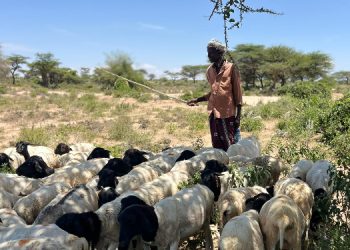
She lost 110 goats out of her herd of 120 animals. Some were taken by militias, but others disappeared during the frenzy of the conflict.
“The war broke out suddenly, so I didn’t have time to search for the animals that ran away. I left everything we depended on to save the children. There is no food left for us, no utensils left for us, no house left for us, no farm left for us, nothing left for us.
The worst problem for us is that we are homeless, we are sheltering the children under old trees in the cold and rain and we have no cooking pot. We are in a wild place and we are wondering how a person without food and being chased by guns can even look for a livelihood,” Maka told Radio Ergo.
Maka’s little children eat once a day, relying on small amounts of food she receives from people in the area. Enduring hunger for long periods is difficult. She left behind a four-hectare farm with vegetables and crops like corn, beans, sesame, bananas, melons, and tomatoes, which she planned to harvest in February. She spent $540 on the farm, with $400 that she borrowed promising to repay after the harvest.
Her husband, who used to work with her on the farm, is now jobless. Maraweyn has no work opportunities.
“We didn’t used to worry about food – we had farms, livestock, and water. Now we are surviving on whatever little help comes our way. The food we occasionally cook comes from the kindness of those around us. We are far from a town and we have nothing. We only hope for God’s mercy,” she said.
They get water from a well four kilometres away, where the owner allows them to drink for free. However, she had been paying $20 monthly for five of her children in Koranic school, with two nearing completion. They are now out of education.
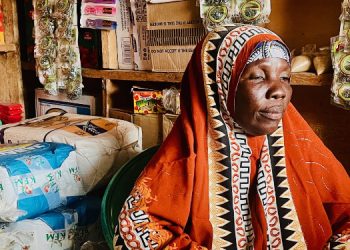
Mohamed Hassan Ali, one of the local elders and a businessman in Eejiye village, told Radio Ergo that his shop, where he sold food and other items, was burned down. The store contained goods worth $5,000.
He explained that his family was separated as they ran, with his wife and some of his children staying with their relatives in War-sheikh, while he and other children went to Maraweyn.
“The conflict has affected us profoundly. The biggest problem is that those we rely on for support are now destitute themselves. The complete collapse of the community’s support system has left everyone struggling. People used to harvest food from their farms, but there are no farms now – all the property was burnt down, and people only saved themselves,” he said.
The families in Maraweyn stay together in groups, pooling their meagre food supplies once a day to cook collectively. Most are agro-pastoralists whose wealth was in their property, farms and animals that were either looted or burned.
Mohamed described how due to a lack of transport, people had to leave Eejiye on foot, arriving in Maraweyn in groups over a span of two weeks.
“People left on foot, as there was no car. The donkey carts were burned, and so people took what they could carry by hand and on their backs.
Livestock, such as cows and goats, were left behind in drought-stricken areas. We have not taken much, we could only take what we could carry,” he said.
According to the elder, the Warsheikh district administration and community leaders had initially attempted to resolve the crisis that began over a land dispute. However, after a week the conflict flared again and spread throughout the village.
There has not been any aid reaching the displaced in Maraweyn. Mohamed said he hoped for conflict resolution so he could return and rebuild his business and home, on the land passed down to him through generations, in Eejiye where he has lived his entire life.