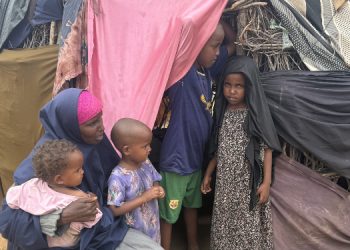


(ERGO) – Jinay Ishak Hassan, a 57-year-old widow, is trying to support her 11 children alone on the barren site where the family arrived on 10 June outside Baidoa, after they fled their drought-ruined farm.
Jinay’s family had planted their crops in March on their farm in Mintanyo, a village 20 km south of Baidoa, but the expected seasonal rains never came.
All she can do is to go out searching for work on nearby farms, hoping to earn something to feed her children. Sometimes she makes 40,000 Somali shillings ($2), but that is not enough to provide even one full meal for her large family. There are days when she finds no work at all and returns empty-handed.
“We have nothing. I beg people for food to feed my children, but it’s never enough. We live in hardship—no water, no shelter, and our farm failed us,” she said.
Jinay and her children walked for two days to reach this area of Baidoa after abandoning their six-hectare farm.
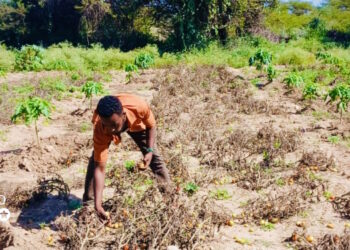
They had hoped to reap their harvest of sesame, sorghum, maize, and vegetables at the end of June, expecting to make $350-500 in income. However, the crops withered before they could be harvested.
This year’s loss was devastating because it marked the third consecutive season of crop failure.
Her husband, who used to manage the farm, died three years ago and Jinay kept the farm going. This year Jinay relied on seeds donated by a neighbouring farmer, but the drought was relentless.
In the 30 years that Jinay and her family have lived off the income from their farmland, this is the first time they have had to flee their home and become displaced.
Without any aid agencies or services in the area where they are camping now, her children can’t go to school.
“When we lived in the countryside, six of my children were in Koranic school. We don’t have schools in this village, they no longer study, they just play around the house,” she said.
The makeshift shelter they are sleeping in provides no protection from the wind and dust and at night her children are exposed to the cold.
Jinay’s situation mirrors the hardships of many families displaced by drought from farms in Bay region. She left behind her home and belongings because they couldn’t afford transport to carry them.
Adapting to life in displacement, with the constant threat of hunger and lack of resources, has been extremely challenging for her family. Jinay said they used to have enough food from their farm, even during difficult times. They had grain reserves they could rely on, but their food ran out in May, leaving them with no choice but to flee.
Abdikadar Mohamed Ali, another displaced farmer from Mintanyo village, shares a similar story. He fled to Baidoa with his wife and four children, but since arriving they have faced similar hurdles. The food they receive from their new neighbours is barely enough for one meal a day.
“We used to cook three meals a day, but now we can only manage one. It’s painful. If we eat today, we don’t know if we will have food tomorrow,” he said.
His four-hectare farm, mainly planted with vegetables, lies bare due to failed rainy seasons. He faces the stress of wondering how to repay a $150 loan he took to finance vegetables that he never harvested.
When Abdikadar arrived in Baidoa, he had hoped to find work, but with no skills other than farming he hasn’t managed to find any employment. His farm depended on rain water and the absence of irrigation systems made it impossible to save the crops.
“We noticed that the crops were drying up. I was thinking to myself tomorrow will be better or the day after will be better, but they dried out completely. We were expecting the crops to sustain us, but they all failed,” he said.
Abdiqadar’s family also lack clean water on this undeveloped site. They have to buy drinking water from a well two kilometres away that costs 2,000 Somali shillings per jerrycan.
The ongoing drought has worsened health conditions, with many displaced families suffering from diseases such as malaria. They don’t have mosquito nets or access to healthcare and medicine.
According to Mustaf Mohamed Hasan, the deputy chairman of the committee formed by the displaced families, new people continue to arrive at this camp every day.
Some are in desperate conditions after fleeing their homes without food or essential supplies. So far there are 120 families in the camp.
“People are coming with nothing. Their situation is dire, and they have no food or shelter. It’s getting worse every day,” Mustaf told Radio Ergo.