

(ERGO) – Shamed by the constant stigma she attracts because of her fistula condition, Hindiya Abdiaziz Mohamud, 55, a refugee living in Kenya’s Dadaab camps, has stopped going out even to do the laundry work that her family partially relied on for a living.
Her husband abandoned her long ago after she developed obstetric fistula, leaving her to raise her seven children alone. Even some of her relatives have distanced themselves from her and avoided helping her as she has struggled with all her responsibilities.
In February, the mental pressure of appearing in public became more than she could bear.
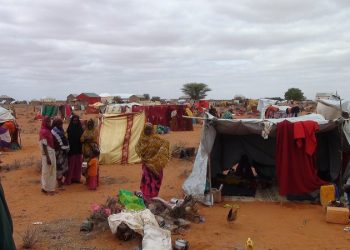
“Whenever I am among people I get stressed. When I’m at the tap getting water people look at me in contempt. They insult me and say this woman is such and such. My children also have to deal with it whenever they go out to play football, or at school. I avoid crowded places including the market and try to keep off as much as possible, so it’s really challenging,” she said.
Her family depends on the food aid rations they receive in the camp: 40 kilograms of sorghum, 12 kilograms of lentils and eight litres of cooking oil. Her eldest son works as a shopkeeper earning $80 a month that helps supports them.
“When I became sick I was young, I only had seven children and I was in my early 30s. Me and my husband got divorced, and I never married again. There are young girls who get sick like me every day,” she said.
Hindiya described to Radio Ergo her memory of going into labour in 1997 whilst walking in a remote area in Afmadow, in Lower Juba region of Somalia, where there wasn’t any health centre. Her seventh child was finally born after a prolonged obstructed labour without any trained attendant helping her.
That left her with the complicated condition that now causes her such physical problems as well as mental agony.
“In bed I have to use diapers at night. We are poor and for me the worst part is that I can’t wait for others to finish so I could use the toilet,” she said.
She set up and leads a fistula support group comprising 49 women living with the condition in Hagadera camp in Kenya. Most of them suffered the complications during childbirth in the hands of untrained traditional midwives.
Although she has undergone surgery several times to treat the condition, she has never recovered.
Muslimo Nadir Ada, 46, a member of Hindiya’s group, said people shun her all the time in the camp and she often talks to herself.
“I can never forget the stigma. I am discriminated against wherever I go. The society, our neighbours berate me, my children can’t play with other children. I sometimes overhear other children insulting my children and they get into fights. I’ve seen this happen more than once, maybe two or three times,” she said.
She lives with her husband and nine children, depending on food aid in the camp and her husband’s wages of $90 a month as a driver.
Muslimo underwent female circumcision at a young age and believes this caused her to develop fistula later on when she had children. She now creates awareness among other women about the dangers of female genital mutilation (FGM) practice.
“I got the complication during my second childbirth. As you know Somali girls are faced with a myriad of challenges, there are norms and cultures. FGM cutting should stop, most of the women who get this condition is because of circumcision,” she said.
Muslimo developed fistula in 1998 and as she went on to have seven more children, it worsened each time and has become hard for her to be fully treated.
Some of the refugee women in the group went through repair surgery between 2015 and 2018 but only a few say theirs was successful.
Fadumo Sidow Yusuf has worked as a midwife for 20 years in Hagadera camp.
“Since the bladder and rectum get affected the women can’t control their bodily functions. People don’t want to associate themselves with someone who has urine on their body for example. The women get stressed and start to think. People often say they have gone mad but it is just the trauma they are experiencing,” she said.
Fadumo advises women to give birth at health centres where the number of fistula cases occurring is significantly lower than with traditional childbirth.