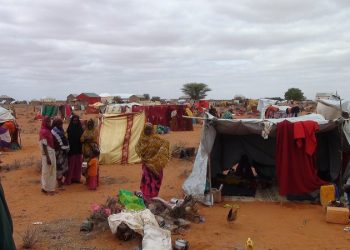
(ERGO) – Poor sanitation and lack of healthcare are increasing the risks of vulnerable displaced families living in crowded camps in the Somali capital Mogadishu to the spread of diseases like acute watery diarrhoea and cholera.
Ahmed Siyad Bulle, a father of six living with his wife in Danyar camp in Garasbaley district, explained that he was forced to stop work and stay at home to watch over his daughter who was bed ridden after falling sick with watery diarrhoea. His wife was taking care of the other children.
His daughter, Asho Ahmed Siyad, became very sick at night on 25 May and he could not access any free medical care nearby. He couldn’t afford to pay for her medical bills in nearby private health centres.
After a desperate search, he found out from other camp dwellers that he could get free treatment at Banadir hospital, where his daughter was admitted on 27 May. One of Ahmed’s friends helped him pay the $5 transport. He remained with Asho in the hospital for two days during her treatment.
This father and many other parents are faced with constant worry, as watery diarrhoea spreads rampantly among the children in camps like this.
“Parents have not gone to work since this outbreak hit. We take care of the children and we can’t work because they need care. The women normally wash clothes and the men work on construction sites. Children need to get to health centres quickly. Parents can’t just stay away and that has affected our livelihood,” he said.
Paying for transport to get to a free hospital is a further burden for these low income families.
Ahmed noted that there is poor sanitation and little awareness in the camp, which puts them at risk of contracting diseases.
“There are no toilets, children defecate in the open, the older people use toilets in neighbouring houses outside the camp. There was one toilet here in the camp but the iron-sheets were blown away by strong winds,” he said.
During the day, Ahmed sells groundnuts in Mogadishu and earns about $2 a day. He returned to work after his daughter recovered.
He also noted that his children don’t get a balanced diet and are at risk of malnutrition and other sicknesses due to their low immunity.
Ahmed and his family were displaced from Iji district near Mahaday, on the border between Hiran and Middle Shabelle regions, in March this year following clan conflict. His house and farm were burnt down in the conflict between warring clans.
Dr Ahmed Said and a group of doctors working at Dawo hospital have been conducting a diagnosis and awareness campaign on communicable diseases among IDPs in Mogadishu. They collected $670 to fund the campaign.
He said he came across families who had kept their children at home despite contracting acute watery diarrhoea because they couldn’t find or afford treatment.
Dr Ahmed said they tested 500 children in two camps, Danyar and Danyar 2, where most of the families living there had come from Middle and Lower Shabelle and Bay regions. Among those tested, he found that 110 children had acute watery diarrhoea or cholera.
He attributed this high prevalence to the lack of toilets and clean water in these camps. He noted that human waste lay all around the camps, while residents were drinking water from plastic containers exposed to the sun during the day.
“Watery diarrhoea spreads when someone eats or drinks contaminated food or water, also if someone gets in contact with human waste from someone who had diarrhoea and they end up ingesting it. The symptoms of this disease include constant diarrhoea and sometimes vomiting,” he said.
He added that it is important for people to maintain proper hygiene and cleaning of eating utensils and other measures to avert the spread of this disease. He shared tips on how people can make a homemade oral rehydration solution for patients affected by diarrhoea.
“You can make it at home. You take a litre of clean water and add five spoons of sugar, half a spoon of salt, and there you have the ORS,” he explained to listeners on the radio.
Camp leaders have also been trying to raise awareness although their efforts are limited by the terrible conditions in the camp and the lack of access to health centres.
The leader of Danyar 2 camp in Deynile, Abas Mohamud Gabow, said there were no health services within the camp. He stated that four children had died in his camp in May due to dehydration from watery diarrhoea.
He said other camps in Deynile and Kahda districts of Mogadishu faced similar problems although some of them at least had toilets.
“There is no clean water for drinking in this camp. The water taps were cut off after we were unable to pay for the water. Now they get water from faraway places. I have been informing the IDPs to boil the water before drinking and to dispose of waste far from their houses,” the camp leader said.