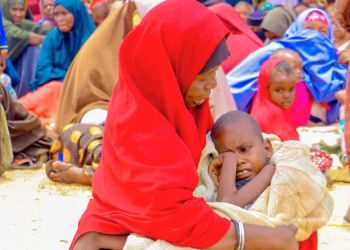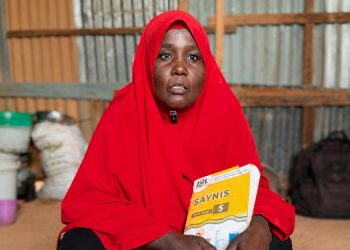


(ERGO) – Mohamed Ishaq Hassan, 40, a displaced father of seven, has enrolled three of his children in an education centre in Afufa camp in Baidoa where the lessons are taught by a volunteer youth group for no charge.
It is the first time that Mohamed’s children have been to school. He described it as the biggest opportunity they have ever had for a better future.
“I never thought my children could get an education. We are IDPs. We thank God since we have got an education,” he said.
His 11-year-old daughter and two older sons have enrolled in grade one at Horizon primary school in Afufa camp, where they received free books, pens and uniforms from the volunteer group, South West state students’ association.
“The reason I have been unable to take them to school is because there were no free schools in the area. They are now happy about their education, they wake up and go to school early in the morning and come back at midday,” he said.
Mohamed works on construction sites breaking rocks for building, earning $75-100 a month which provides the family with two meals a day. He and his family live in a small shack made of plastic bags and tree branches tied together by pieces of cloth. They do not receive any aid and trying to raise school fees was beyond his means.
“Although there is no longer drought in our home villages, we don’t have the money to go back. But also my children have now got an education so we will not go back,” he stated.
Mohamed and his family migrated from Ufurow, 130 kilometres from Baidoa, in December 2021 after their five-hectare farm failed due to drought and water shortage.
Meanwhile, Hafid Abdullahi Ishaq, an IDP father in Hawalaha Guud camp on the outskirts of Baidoa, enrolled his four children in nearby Darul-Kheyr primary and middle school, under the same free teaching scheme.
Hafid said he always wanted his children to be educated although he had been unable to afford the fees.
Speaking about his eldest 15-year-old son he said: “I hope that he will work using his pen, and his education level will rise. I envision that he will become a translator and work with aid organisations, that is my hope.”
This impoverished family is lucky if they eat two meals a day, and like many others in a similar situation education was a secondary need.
He digs rubbish pits and latrines, earning $2-4 a day whenever he gets called. Life has been a struggle since they joined the camp three years ago.
“Sometimes we get food and sometimes we don’t. If I get a job two days running, I might not get work again for three days. Whether I earn an income or not, my family depends on me for a living,” he said.
They were displaced from Gelgel village in Bardale, Bay region, after losing 80 goats and 30 cows to drought in March and April 2020.
“If I had got livestock I would have gone back. But I cannot go back because I don’t have the animals,” Hafid said.
The two schools, Darul-Kheyr and Horizon, have taken in a combined total of 300 students from Afufa and Howlaha Guud camps to be taught by the volunteers.
The chairman of the student volunteers, Abdirisak Abdi Ishaq, said the programme had been developed in discussion with the two schools. Although there are many other children wanting to join, they could only accept 300 students for now.
Abdirisak said that 50 youth volunteers in their group had raised $1,000 to buy the school children stationery and uniforms.
“We developed this idea when we saw the need for education in the camps and the lack of schools. We hope that we will provide an education for 1,000 students this year. We will continue to raise awareness,” he said.