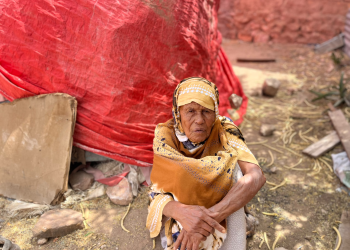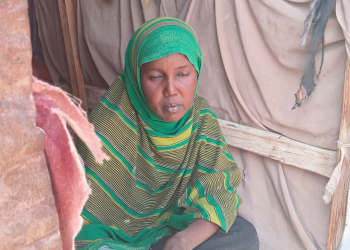


(ERGO) – Addey Abdullahi Adan, a widow, and her nine children joined Mog-iyo Arow camp in the southern Somali city of Baidoa on 13 August, fleeing conflict in their already drought-affected village in Goof-Gadud in Bay region.
However, the crowded IDP camp has offered Addey and her children little protection and she has not received any aid.
She spends eight hours a day on the streets begging from Baidoa residents and is lucky to get enough to put one meal together for her children.
“We don’t have plastic sheeting, we don’t have food, we don’t have water, we have absolutely nothing today,” Addey complained.
“We’ve been displaced from Goof-gadud and we’ve encountered hardship here. Other people were helping us with some food but they too are destitute and they can’t do much for us, it’s only God who can help us. We don’t have anything, just problems!”
Back home, Addey and her family were farmers owning a four-hectare farm. They dropped their farm tools and fled as the conflict grew closer and there was growing fear for their lives.
This mother swiftly gathered all her children and they trekked for three days to the IDP camp from Goof-gadud, about 30 kilometres northwest of Baidoa.
“We had a hard time getting here as we had no vehicle for transport. We were rearing livestock but they were all depleted, and we didn’t plant anything on our farm for two years due to drought and now conflict. The children’s father is not alive and I have the children alone. If we cook at night, we don’t cook in the morning and eat the leftovers from the previous night,” she said.
Addey said she lost 200 goats to drought spanning over three years. She had to pull her three children out of school as she could not pay the $30 fees. When the conflict erupted there in August, there was nothing left to do but flee.
With heavy rainfall predicted, however, the cardboard shelter they are sleeping under in the camp at night risks disintegrating around them. In the daytime, they simply rest in the shade of trees.
With so many people fleeing insecurity in Bay region, as the war intensified between the Somali government forces and al-Shabab, the camps are overcrowded and the fragile local support systems cannot help those arriving.
Isho Adan Madkus arrived in the camp on 21 August with her family of 10 people from Daynuney, 30 kilometres southeast of Baidoa, travelling on donkeys. They are living crammed into one room in a relative’s house in the camp.
“We don’t have food or water, we fetch the water from a well far away, and we buy one jerry can of water at 2,000 shillings,” she said.
Isho wakes up every morning to wash clothes earning $3-4f she finds a job. She usually makes enough for only one meal a day for the family. She is the only income earner in the family, as her elderly husband cannot take on labour jobs.
Two of her children have been sick since 27 September and although she suspects it could be malaria, she says she has no money to take them to a health centre for treatment.
She owned a three-hectare farm in her area and hopes to return there if security is restored.
“If our area returns to how it was through God’s grace, and we get rainfall and work, we would return home because that is what we want,” she said.
The camp leader of Mog-iyo Aarow, Adan Aliyow Ibrahim, told Radio Ergo that 800 new families had joined the camp in August, adding to the 1,000 families already living there.
He said they welcomed the new families although they cannot keep pace with the arrivals and have no capacity to support them with the basic needs.
“People used to arrive in groups of about 10 people, so we went to the businessmen to borrow rice and flour, or we went to the people in the city asking them to help us feed the displaced people. But with the growing number of arrivals in the camp, we’ve been unable to help,” the camp leader said.