Radio Ergo - Somali Humanitarian News and Information
  • Home
  • Topics
    • Latest Stories
    • IDPS/Refugees
    • Natural Disasters
    • Health
    • Social
    • Food Security
    • Education
    • Agriculture & Livestock
  • Programmes
    • Locust Programme
    • Farming Programme
    • Radio Doctor Programme
    • Women Programme
    • Entertainment Programme
  • About Radio Ergo
  • Contact Us
  • blankSomali
  • blankEnglish
No Result
View All Result
Radio Ergo - Somali Humanitarian News and Information
  • Home
  • Topics
    • Latest Stories
    • IDPS/Refugees
    • Natural Disasters
    • Health
    • Social
    • Food Security
    • Education
    • Agriculture & Livestock
  • Programmes
    • Locust Programme
    • Farming Programme
    • Radio Doctor Programme
    • Women Programme
    • Entertainment Programme
  • About Radio Ergo
  • Contact Us
  • blankSomali
  • blankEnglish
No Result
View All Result
Radio Ergo - Somali Humanitarian News and Information
Home IDPS/REFUGEES

Refugee beekeeper sells honey in Dadaab

Radio Ergo by Radio Ergo
October 18, 2023
in IDPS/REFUGEES, LATEST STORIES
0
Refugee beekeeper sells honey in Dadaab

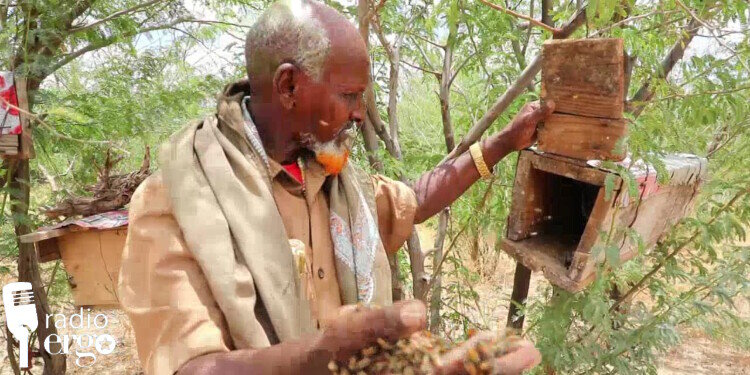
Bee keeper checks his bee box as he prepares to harvest honey/File Photo/Ergo

0
SHARES
Share on FacebookShare on Twitter

(ERGO) – Omar Abdullahi Adan, 67, a Somali refugee living in Dadaab camps in north-eastern Kenya, is well known among the refugees for beekeeping.

He earns $200-$250 a month from honey sales that supports him and his family quite well.

“I don’t have any other work; I only get my income from bees. I married my wife with money I made from beekeeping. On my best day I made 32,000 Kenya shillings ($213) from the honey sales,” he said.

He keeps his bees in 21 boxes in a farm four kilometres away that he fenced. He goes there every morning to take the bees water.

His main customers are others living in Dhagahley the refugee camp, and he also has occasional orders from Nairobi or Dhobley in Lower Juba that he delivers through people travelling to those areas. He sells half a litre of honey for 1,200 shillings ($8) and three litres discounted at 6,000 shillings.

Omar managed to save $360 from honey sales in 2017 and bought one goat and two camels. His livestock have multiplied since then and he now has seven goats and five camels, herded by his relatives outside the camp.

He pays $32 a month in fees for six of his eight children studying at Koranic school.

Omar fled conflict in Bu’ale, in Somalia’s Lower Juba region, in 2015 and joined the refugee camp. He brought with him $56 from his bee keeping business in Bu’ale and used the money to start off in Dadaab by buying three boxes to store the bees.

Surviving on the 48 kilograms of sorghum and 4,950 shillings ($33) his family were allocated in aid was very hard. He feels that others in the camp could consider beekeeping as well to make a decent living.

Omar began beekeeping at the age of 15 and remembers his early novice period.

“The first day I tried to catch bees with no experience, I was stung badly. I fell unconscious and people had to splash water on me. I was carried away in car, I even vomited, but now I’m experienced I don’t get hurt!” he said.

Lacking any protective gear, he relies on the old method of using smoke to make the bees sleepy so they can be caught.

“There are three types of bees, dark bees, red bees, and striped bees. The red bees are very good for producing honey and I have collected them from all around Dhagahaley. To catch the bees, I smoke the bee hive on the tree so they start to fly out. That’s when I catch the queen bee and the rest of the bees will follow the queen. That’s how I trap them and take them to my hives,” he said.

He noted that bees only produce honey for six months of the year and spend the rest of the year reproducing. As trees, flowers, and water have been scarce during the recent drought, he has special means of keeping the bees productive.

“Whenever there is drought, I grind maize and put in on a plate on the tree. I also prepare tea, with cinnamon and cloves to give a good smell. The bees eat the food and drink the water and that’s how they keep producing the honey,” Omar explained.
Previous Post

Baidoa camps fill up with families displaced by war in Bay region

Next Post

Mudug pastoralists train as electricians in Galkayo

Related Posts

Clan conflict causes hundreds of families to flee burnt farms in Bay region
IDPS/REFUGEES

Clan conflict causes hundreds of families to flee burnt farms in Bay region

April 24, 2026
Somalia live news, Somalia latest news, Mogadishu live news, Somali news
FF Feedback

Radio Ergo audience feedback report 16-22 April 2026

April 24, 2026
Families in Lower Shabelle get new chance to build up a living
FOOD SECURITY

Families in Lower Shabelle get new chance to build up a living

April 22, 2026
Credit crunch faces drought-stricken pastoralist households in Adado
FOOD SECURITY

Credit crunch faces drought-stricken pastoralist households in Adado

April 20, 2026
Airstrikes wipe out livelihoods in Lower Shabelle farming village
FOOD SECURITY

Airstrikes wipe out livelihoods in Lower Shabelle farming village

April 17, 2026
Somalia live news, Somalia latest news, Mogadishu live news, Somali news
FF Feedback

Radio Ergo audience feedback report 9-15 April 2026

April 17, 2026
Next Post
Mudug pastoralists train as electricians in Galkayo

Mudug pastoralists train as electricians in Galkayo

FOLLOW US ON FACEBOOK

DAILY PROGRAMMES

IDAACADDA 28-APR-2026

IDAACADDA 28-APR-2026 by Radio Ergo

IDAACADDA 28-APR-2026
Episode play icon
IDAACADDA 28-APR-2026
April 28, 2026
Episode play icon
IDAACADDA 27-APR-2026
April 27, 2026
Episode play icon
IDAACADDA 26-APR-2026
April 26, 2026
Episode play icon
IDAACADDA 25-APR-2026
April 25, 2026
Episode play icon
IDAACADDA 24-APR-2026
April 24, 2026
Search Results placeholder
Radio Ergo Weekly Newsletter
We respect your privacy.
blank
blank
blank

© Copyright 2014 - 2024 Radio Ergo

No Result
View All Result
  • Home
  • Topics
    • Latest Stories
    • IDPS/Refugees
    • Natural Disasters
    • Health
    • Social
    • Food Security
    • Education
    • Agriculture & Livestock
  • Programmes
    • Locust Programme
    • Farming Programme
    • Radio Doctor Programme
    • Women Programme
    • Entertainment Programme
  • About Radio Ergo
  • Contact Us
  • blankSomali
  • blankEnglish

© Copyright 2014 - 2024 Radio Ergo