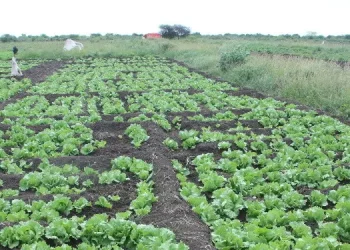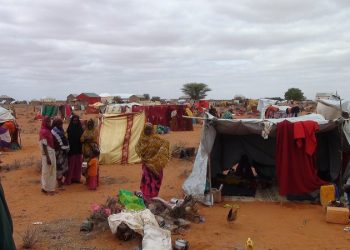


(ERGO) – After being given free land for farming, Abdiaziz Abdi Olow, now living in El-Jalle IDP camp near Kismayo, has reaped a substantial amount of food that he is sharing with other hard-up families in the camp and selling to earn a living.
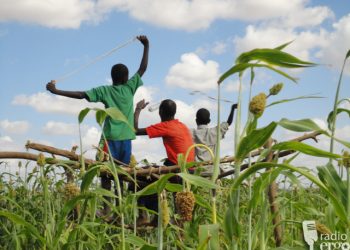
His harvest from the one hectare given to him by Jubbaland authorities totalled six sacks of maize, three sacks of beans, 10 kilograms of tomatoes, and 500 watermelons.
He said he distributed three sacks of the grain among three neighbouring families in the camp and saved the remaining three sacks of grain and beans for his family. He sold off the watermelons in the market earning $510.
“We sold some of the watermelons in the camp for $1.5 and the rest were sold in the Kismayo market for $2.5. We have felt a positive change in life and it was a motivation for us to continue farming. When we came here we had nothing and were looking for aid,” said Abdiaziz, who came to the camp in Qaam Qaam last October after his farm in Harbole village in Afmadow, Lower Juba, was ruined by drought.
“There was no rain on the farm. The livestock got sick – I had 50 cows, only six are left. I gave the remaining cows to some people and asked them to look after them and left with the children, that is how I ended up in the camp.”
Abdiaziz knows his family will not sleep hungry now that he been able to return to productive farming. He has paid off his $100 debts at local shops and enrolled five of his 10 children in Koranic school.
He explained that he was not obliged to help his fellow IDPs, but decided to share the farm produce as he could understand the hardships other people suffered in the sprawling camp.
Jubbaland State Ministry of Agriculture, with support from the German government’s development agency GIZ, gave one-hectare farm plots to 100 drought-displaced families in the camp, along with farming equipment including shovels, axes, and ploughs. They also donated seeds and generators to help farmers to draw water from the river.
After planting in January, the farmers began harvesting on 28 April.
The coordinator of the Ministry of Agriculture in Lower Juba region, Ahmed Nur Bile, said the farms were awarded to IDPs with prior knowledge of farming and with large families with little or no income.
Among those helped by donations of the locally grown food is Mohamed Khalif Hassan and his family of nine children living in the camp. He was given food by a fellow IDP who farmed on a plot of land he was allocated last December.
Mohamed said he was given 30 kilograms of maize for his family and fresh produce such as tomatoes, pumpkins, and watermelons. They are now enjoying three meals a day.
“You realise that a sack of maize can last a whole month! It saves you from buying other food stuffs. We used to cook only twice a day, so now that we have the maize we are doing much better,” he said.
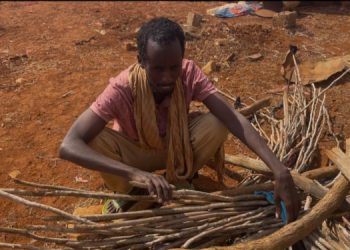
He has been living in the camp for a year and a half and only managed to find casual jobs on construction sites every now and then. It is hard to commute to the nearest town, Kismayo 25 kilometres away. If he gets called up for construction work, he comes home with just $3.
“There is no work in the area, the people depend on the farms and a few other jobs. As a family, the food we get is the most important thing for us. If you are given some vegetables, you can take rice on credit or use what little money we have to buy it,” he said.
Mohamed and his family were displaced from Hosingow in Lower Juba in December 2021 after losing 50 cows and 60 goats in the drought.
He is among 150 displaced families in Qaam Qaam, north of Kismayo, who have received food assistance from others now re-engaged in farming.