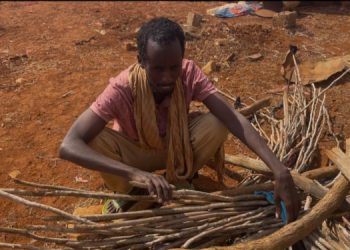
(ERGO) – Abdi Macalin Fiqi, pastoralist living in Galgadud, central Somalia, is happy to see his livestock recovering from various diseases and regaining full health after receiving veterinary treatment from Galmudug’s ministry of livestock.
He had lost 30 from among his herd of 330 goats and 10 camels in Kabawar village near Adado. Diseases had made his animals feeble and they were not producing milk or meat. He feared they could all die.
On 15 March, however, his animals were treated without charge for diseases such as goat plague, Contagious Caprine Pleuropneumonia (CCPP), and goat pox.
“There is a big difference between a sick animal and a healthy one. After being treated there has been a notable difference. They are grazing well and they can be sold off. They are producing milk now. They were dying of disease and starvation but now they don’t have any problem,” Abdi told Radio Ergo’s local reporter.
While the animals were too thin and sickly to sell, he was forced to take $2,000 in loans to feed his family of six children over the past six months.
After the treatment, he managed to pay off $700 on 15 May after selling some of his goats.
Like many pastoralists living in remote areas, Abdi had tried to treat his livestock on his own.
“I didn’t know how to treat them. I live in the rural areas and I don’t have any education. I injected them with various medicines although their health didn’t improve, so I think it was not the appropriate medicine,” he said.
“This work came at the most suitable time when the animals were too sick. When we received the help and our livestock got health, our lives changed a lot,” he said.
The treatment campaign also reached Abdirisaq Mohamud Adan’s village of Furaar, near Hobyo in Mudug. Abdirisaq lost 200 goats to the drought last year, and with 140 goats remaining he was struggling to support his family due to diseases plaguing the herd.
His goats had not been breeding for seven months due to sickness. They were treated for mastitis, CCPP, goat plague (PPR) and goat pox and are now regaining their health.
“We were faced with various challenges including lack of knowledge of the diseases. A friend who knew my livestock were sick came to see me after the livestock were treated and told me there was a big notable difference,” he said.
He took $2,500 in debts to take care of his wife and 13 children. Now that his livestock are recovering he was recently able to sell 13 goats in Galkayo livestock market for $800.
“There wasn’t a single goat in the herd that could be sold, they were all weak and had no meat. When I got the treatment I was able to sell some of them. I am now paying off the debts I took from the local stores. That has special importance for me,” he said.
The director of Galmudug’s Ministry of Livestock, Dr Suleiman Mohamed Farah, said the treatment campaign targeted 25 areas in Mudug and Galgadud, where more than 1.7 million animals were treated over a month.
He said the livestock were vulnerable to disease following four consecutive years of drought.
Whilst 11,305 livestock owning families benefited from this campaign, they were unable to meet further demand for treatment. The ministry has requested the funder, the World Bank, to support a second phase of vaccination and treatment.
“The animals needing treatment were more than the number covered, we have treated 20 per cent of the animals. So the work we have done is small compared to the need. Twenty five teams were sent to the areas, each team working in 10 villages. They worked in a planned and orderly manner,” said Dr Suleiman, who was among the livestock treatment team.
The treatment was carried out in collaboration with the Association of Veterinarians in Central Regions, CERELPA. The vets raised awareness among pastoralists on how to separate healthy animals from sick animals to contain the spread of diseases.