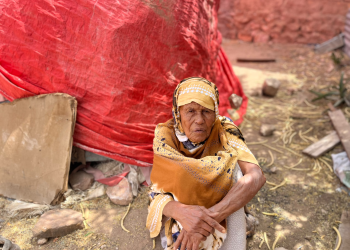


(ERGO) – Dhaqan Dahir Abdullahi was jubilant about harvesting 10 sacks of maize and beans from her two hectare farm in Luq, Gedo region, in February.
She will be able to feed her family for the next four months as well as earn cash from selling the excess in local markets to cover her eight children’s needs.
“Now we get to cook twice a day. We have water too. I own everything grown on this farm and I am happy to be a farmer. When I was living in the rural areas I worked for someone else but now I am independent,” said Dhaqan.
Dhaqan, 52, who lives in Kulmiye IDP camp in Luq, was among 280 hard-up families given land in the area by a local NGO late last year to reestablish their livelihoods. Generators to access water, seeds, and agricultural training were also included.
When Dhaqan, a widow, first came to Kulmiye camp in September 2022 she had no means of earning a living and had to depend on her neighbours for a meal.
Earlier, she abandoned the family’s own three-hectare farm in Halul near Garbaharey, after everything including their 80 goats were destroyed by drought. She then went to work on another farm in the area, but that failed too due to the drought.
However, now Dhaqan is also selling animal fodder that she grew on her land near the camp to drought-hit pastoralists, earning about $2 a day. She is preparing the farm for her second planting season.
“I have three girls living with disabilities. I was doing odd jobs to support them and sometimes I earned and sometimes come back with nothing, but now we are doing better and I am living off the farm,” she explained.
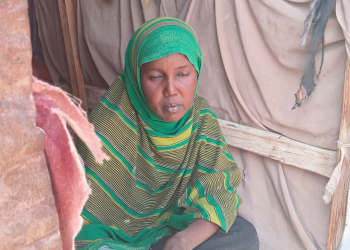
Another IDP mother, Kheyre Diriye Abdi, 45, has been working on the three-hectare farm she received three kilometres from Luq.
“We are now earning from the farm and selling off the excess. I have enrolled three of my children in school,” said the mother of nine. Her husband is unemployed and sometimes helps on the farm.
Kheyre’s family were displaced from Quran-gago village, 45 kilometres from Luq, where they lost most of their 120 goats over four devastating years of drought. They finally sold off the last few goats before they died and moved to the IDP camp.
Abdi Hussein Muhumed, a former pastoralist from Burdubo, came to Kulmiye camp last July and now supports his family of four on the one-hectare farm he was given. He works 12 hours every day, spending extra time fending off wild animals including pigs and birds that are especially voracious as they are also affected by drought.
“I am this old and I still stay on the farm for the entire day, though I can’t stay there at night!” said Abdi, who is 60. His family is now able to eat three times a day because of their income from the farm.
Camp leaders identified the most vulnerable families to be supported with land. This project, which has enabled the farmers to use the farmland for four years for free, was funded by Trocaire and implemented by SIRAD. It is not clear what will happen to the land after that period.
Training for the farmers included how to plant Neem trees, whose extracts can be used to fend off crop pests.