

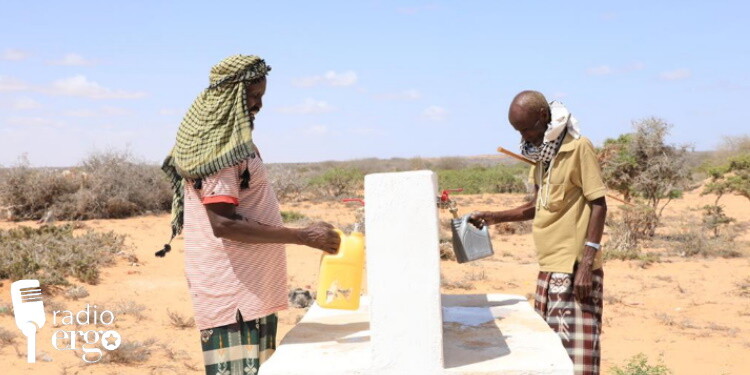
(ERGO) – Nearly 3,000 pastoralist families are now getting access to free water from 11 water points that have either been newly constructed or renovated in locations across Mudug and Galgadud regions.
With no boreholes in these areas, families had to walk long distances to get water for themselves and their livestock or to spend large amounts of money buying water.
Jamad Hashi Diriye, living in Liban-buq’ad village, 22 kilometres west of Guriel, said she and her family of 12 people are now getting enough water from the water catchment near them that has been reconstructed by the Galmudug government.
“The water catchment has been cleaned and repaired, and as the livestock and donkeys used to enter it has also been fenced. We get water through pipes just like the people in the towns! We are now doing well and we thank God,” she told Radio Ergo.
Jamad lost 150 out of her 200 goats during the drought. She decided to open a small restaurant a year ago investing $230 from her sister in an effort to supplement their diminished income. However, water was costly at $3 a barrel and the small business income only covered he family’s food. With her elderly husband not working, she is the breadwinner.
“I was buying a jerry can of water, or getting it delivered from far places, but now we are using pipes to get water. This has made a huge difference, as I would get little income to provide for my family and I couldn’t make any savings.”
In the past two months her profits have risen, as she no longer spends money buying. Also, the water point means there are more customers around in her restaurant as people are no longer migrating in search of water.
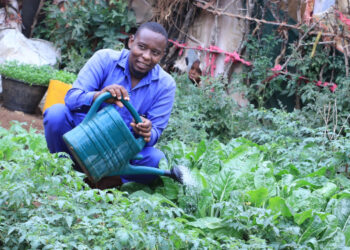
She is also able to irrigate daily the maize, sorghum, watermelons, beans and tomatoes she planted on her two-hectare farm, which she hopes to harvest and sell in January.
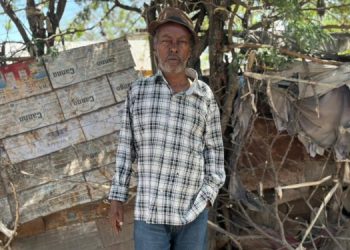
At another of the water points, Abshir Adan Shire in Hingod village, 102 kilometres north of Hobyo, is relieved to be able to water his 300 goats and 30 camels for free as required.
“The water has made an important difference to us, and we get it easily. We thank God we no longer face water shortage and thirst, we just rush to the water points whenever we need water,” he said.
Buying water for the animals before was costing him $300. This forced him to migrate twice in 2022, travelling 40 kilometres to El-lahelay with his livestock. He spent $2,500 on water and transport for his livestock and family of 14 including two wives.
The water catchment installations in Galmudug were developed under a national project called Biyole, implemented by the federal government with a loan from the World Bank.
The Galmudug director of Biyole, Abdalle Ahmed Suleiman, said the project aims to provide water for agricultural and pastoralist uses in drylands and will continue over 25 years.
The water points are lined with plastic that can hold water harvested from rainfall for more than 20 years without leakage, after which they may need refurbishing. The work has included piping water from the catchments to water points and troughs for people and animals to use.