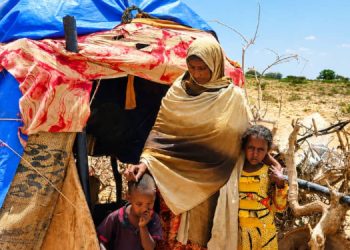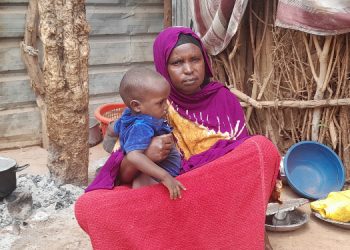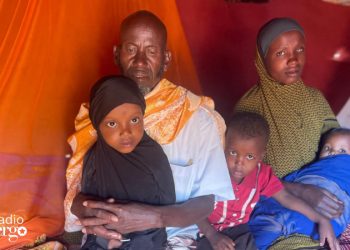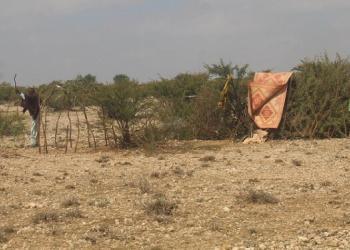
(ERGO) – Some of the families who fled to the central Somali town of Adado after being displaced by conflict between government forces and Al-Shabab have been given housing – although half the families are still sleeping rough.
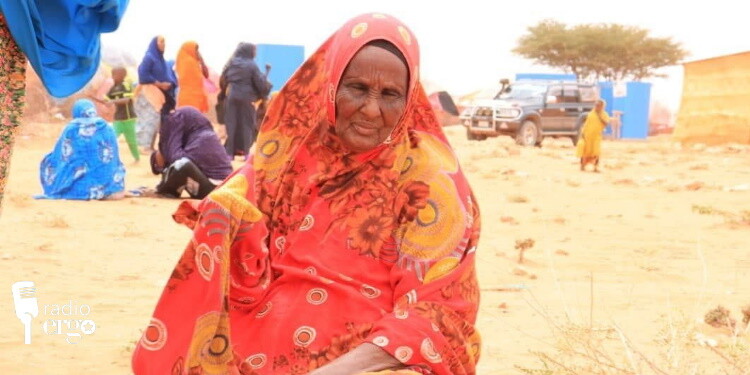
Nadifo Mohamed Hussein, 48, who is paralysed in her right leg, moved with her family of 10 people into one of the 100 wooden houses built in Aymis camp. The houses are being shared by about 350 families.
“We are four families living in that house. The difference is that we were previously living in small shack make of tree branches and pieces of clothing that couldn’t protect us from the wind or the sun. We were vulnerable to thieves, but we now have a house with a door and our situation has improved,” she told Radio Ergo.
Nadifo and her family were living in Ado-kibir, 65 kilometres from Adado, where they kept 130 goats. They fled when conflict between government forces and Al-Shabab erupted, killing 20 of their goats in exchanges of fire in an area where the goats were grazing.
Nadifo’s husband took their remaining livestock to Dhaga-dheer, 25 kilometres from Ado-kibir, to find water and fodder, whilst she brought the children to the camp.
The housing project, organised by the local authority supported by NGO, Mercy Corps, also provided solar panels and some utensils and blankets for the families.
However, food and water are hard to come by and Nadifo can only provide one meal a day for her children, including the youngest who is two years old.
“We previously lived in our home area so there we would get food on credit from the local stores, but when we became displaced we were faced with hardships, and we don’t know where to get food on credit now,” she said.
There are a total of 726 families living in the camp and among the hundreds who have not been housed is Deeqo Dahir Osman, a mother of eight. She still lives in a small makeshift hut and is constantly worried about burglars coming in and stealing their few belongings.
“When I see those people, I become sick to my stomach, we can’t sleep at night due to the fear of getting robbed. We stay up all night guarding ourselves. During the day we are like everyone else but at night we are different from the people who have got houses,” she said in distress.
Deeqo’s family was displaced from Marsamage, 120 kilometres from Adado, where they depended on their farm produce including maize, sorghum, and watermelons. She still owes $150 for the bus fare that brought them to the camp when they had to flee the conflict-torn area. She does not know how to raise the money to repay the debt.
Since she joined the camp in September 2022, she has been washing clothes to make ends meet for her family although it is hard to work and take care of the children.
“My children don’t go to school not even Koranic class because we can’t afford the fees. If I had the capacity I would take them all to school,” she said.
The leader of Aymis camp, Hassan Isse Afrah, told Radio Ergo the families selected were the most vulnerable. He understands the desperation of others who also need housing.
“If the people continue to be in this situation, we could see malnutrition among the children. There could be a dire humanitarian situation including disease outbreaks due to the poor sanitation. We pray for God to protect us. We need well-wishers to help us,” he said.
The land the IDPs are living on is privately owned and the IDPs fear that they could be evicted as they have no security of tenure.