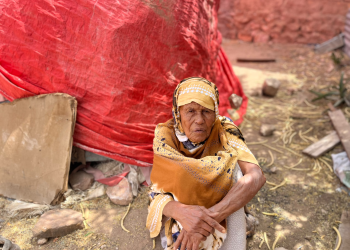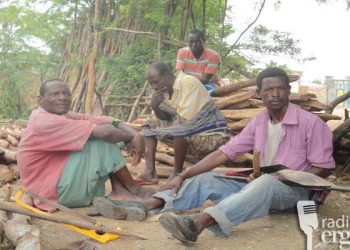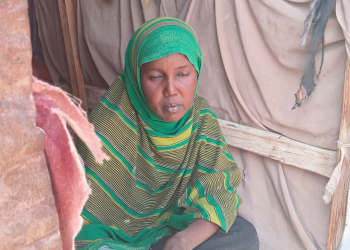


(ERGO) – Waris Hashi, a mother of 12, is under enormous stress having left her husband and half her children behind in their drought-hit village of Sabo’ad in central Somalia’s eastern Mudug region to find food for her most vulnerable children in the nearest town.
With the livestock they depend on for a living sickened by a new wave of disease in the rural area, Waris walked with her four youngest and two daughters to their grandmother’s house in Budbud, 25 kilometres away.
Her family once boasted a large herd of 300 goats, although about 100 were wiped out by contagious diseases while the remaining animals are now sick. Pastoralists in the village think it is the contagious caprine pleuropneumonia (CCPP) disease, although it has not been diagnosed by veterinary experts. The livestock losses have taken a huge toll on their livelihood.
“We didn’t have food, and we didn’t have money to buy any food,” Waris told Radio Ergo.
“Our livestock became sick, and there were no buyers. We are living in great uncertainty, and we are just depending on handouts from people in Budbud.”
Her husband is staying with the six older or strongest children trying to keep the remaining livestock alive in the rural area.
The family used to eat three meals a day, but their situation reduced to being lucky to find one meal and some tea. They accrued loans of $800 over three months that they are unable to pay back.
Waris said the food shortage in Sabo’ad affected the growth and development of the children under the age of five.
“The loans were for food that we took, as well as medicine and milk powder. The shop owners refused to give me any more loans. They told me to clear off the previous debts first,” she explained.
Waris feels ashamed that her children have never been to school because there were no job opportunities in Sabo’ad, and she cannot even contribute towards the grandmother’s rent.
Hundreds of families are living in similar conditions in this remote area on the coastal side of the vast region, 90 kilometres from Garad.
Rage Said Hassan, a father of 13, is also struggling to support his family since moving them to their relatives in Budbud on 15 September. He noted that his children only get to eat one evening meal during the entire day.
His herd of 500 goats in the village has been whittled down by the drought and disease to just 60.
“When the rainfall started the livestock got sick. We thought the livestock would recover by now but we saw them shivering with diseases. Out of every 10 animals only two survived,” he said.
They have bought water and food on credit and need to settle a debt of $4,000. They are living in poor shelter and his children are not going to school.
“We don’t have proper housing, we sleep in a makeshift rental house, it’s temporary. It is not a place that we can count on,” Rage said.
He is becoming increasingly concerned about their situation, saying they need humanitarian intervention including livestock treatment and medicines so they can save their animals and livelihood.
For Gedi Hassan Diriye, and his family of three, it seems too late now to save their pastoralist way of life. He moved to town after things became unbearable in Sabo’ad area in September.
Some food is delivered to Budbud by the UN’s World Food Programme (WFP). Gedi says they survive now on 10 cans of sorghum they have been getting for two months.
“We don’t have anything. We were pastoralists in the rural areas. Drought and disease struck us, and we moved to the city without anything. We are living in rental houses and only get sorghum and some wheat,” he said.
Just three thin goats have survived from his original herd of 400 goats. Gedi is working now as a porter and is earning $70 off-loading goods from trucks in town.