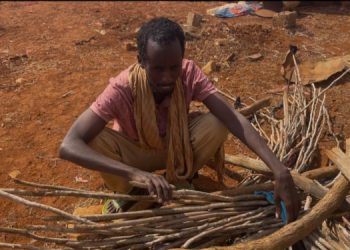


(ERGO) – Ismail Dahir Nur, 65, migrated in February from Bursalah to Galkayo city seeking a better life for his family, as drought had parched the rural areas leaving them with just 10 of their original 200 goats.
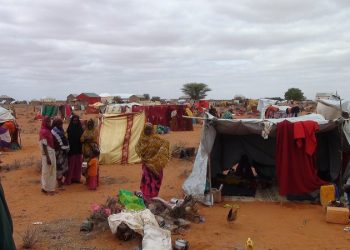
The family of nine children are living in a small makeshift shelter he constructed in an IDP camp.
“As you were calling us, strong wind began to blow and we were afraid it could carry us away, but it has stopped now. Our shelters can’t protect us from the sun or the wind … I have never seen a drought this severe. I haven’t even heard something like this from the older generations,” Ismail told Radio Ergo’s local reporter by phone
Ismail gets occasional work in a quarry earning eight dollars. With no fodder in the camp, he uses this money to buy sorghum for his remaining goats, in the hope of reviving his proud pastoralist lifestyle one day.
His scanty income can barely cover their basic needs and luckily his relatives helping six of his children to stay in school.
Although newcomers like Ismail joined the IDP camps this year hoping to find help to get them back on their feet, they are living alongside escapees from the earlier drought of 2016-2017 who have still not been able to rebuild their lives.
In 2018, Deeqo Ahmed Mohamed, a mother of six, moved with her family to Bali-Abaar camp, 11 kms outside Galkayo, from Goldogob with their last six goats from their herd of 200. Relatives allowed them to live in their house as they had left the camp. However, the relatives have hit hard times again and want to return.
“We were pastoralists and after we lost our livestock we had to migrate to the camp. We didn’t have anywhere to live and one of my relatives allowed me to stay in their house as I look for another house. They have now told me to move out because they want to move back to the camp. I don’t know where to go with my six children,” she said.
Deeqo said getting food was their main concern, but now she must think about finding shelter. Her husband works in a quarry and they depend on their neighbours for food.
“We cook sometimes, and we skip meals sometimes, we don’t get regular income. If we are alive, we will get whatever we were meant to get, but finding shelter is a big worry for us,” she said.
None of her children including her eldest son aged 11 are in school, as they cannot afford the $5 fees for local Koranic or primary schools teaching up to grade four.
“None of my children can even read since they have never been to school. Other children walk around the neighborhood with books, and my children obviously don’t feel very good,” she said.
Sadio Abdille Adan and her family of six children arrived in Madina camp, 11 kms from Galkayo, after fleeing Jarriban in Mudug in 2020 with their last five goats. Seeing them huddling in a flimsy hut, a neighbour invited them to stay in their house but now they have to move out.
“We got help from a man who was worried about our situation and he gave us a room, although he has now informed us that his son is getting married, and they need the room. We don’t know where we will move to,” she said.
With a new baby to care for, Sadio feels uncertainty looming. Her husband earns small irregular wages portering in Galkayo.
“Sometimes when we don’t get food for days and we tell the people about our situation, some give us milk while others give us water, or sugar or rice,” said Sadio.
In mid-August, Galkayo district administration and the UN refugee agency, UNHCR, conducted a joint survey in 18 IDP camps to observe conditions for IDP families. Amongst their many needs, shelter and land allocation were identified as a priority.
Galkayo district administration secretary, Abdirahman Farah, said they found that 12,000 families in various camps had extremely poor shelter that could not protect them from wind or sun. Most are pastoralists dispossessed of their livestock and livelihoods.
He said around 7,000 families of these families were displaced by the drought in 2017, with just over 5,000 arriving since 2020. Land has been allocated for them in areas to the west and east of the city.
“As the local government we have given these people space where they can settle. We have tried to allocate 15m by 10m plots for each family and in the future, they can get documents to register their piece of land,” said Abdirahman.