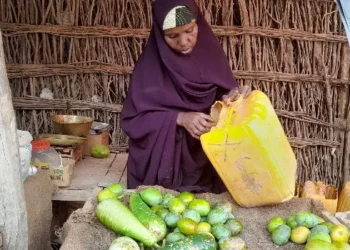


(ERGO) – Fatumo Nur Mohamed, a widowed mother of three, had to abandon her home in Qoryoolay internal displacement camp in Mogadishu’s Kahda district after fire from a charcoal production site burnt down her family’s house.
“It cost me $200 to build that house, part of it was made of iron sheets and the rest was sticks,” she told Radio Ergo. “Charcoal was being burnt near my house. The fire reached my grass roof. Luckily, my children who were at home were rescued by my neighbours.”
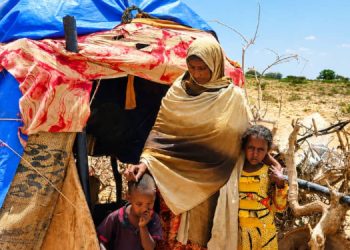
Fatumo’s was among 20 houses burnt down by this fire in May. She moved to Al-Nacim camp in Deynile district and had to start life over again, living under a tree with plastic and cloth strung across the branches as a roof shelter.
Fatumo used to work the whole week doing laundry jobs, but now she works only five days due to the long distance.
“I have to wake up very early in the morning and walk four kilometres to look for work to feed my children,” she said.
She moved to Mogadishu from Bayaxow village in Jowhar in Middle Shabelle region in 2019 after floods destroyed her small shop.
Radio Ergo’s local reporter found that 465 poor families have been forced to abandon their homes in Qoryoolay, Kooweyn, Daryeel, and Wallaweyn IDP camps in Kahda district due to the threat of fire and pollution posed by seven charcoal-burning sites around the camps.
Mohamed Adan Isack moved from Kooweyn to Kulmis camp in May after his neighbours’ houses burnt down, following a fire that spread from the charcoal sites. Three of his children fell sick after inhaling smoke.
“It was an evening and I was not at home when the fire caused by the charcoal site broke out in our camp. My wife could not evacuate the children quickly and they suffocated from the smoke and eventually fell sick,” said Mohamed.
When he came home he rushed his children to hospital for treatment. The bill came to $260, which was settled for him by a well-wisher.
Mohamed, a former pastoralist, came to the city in 2017 when drought killed the family’s 69 goats. He makes about three to four dollars a day using a wheelbarrow as a porter.
The father of eight told Radio Ergo that Kulmis camp is four kilometres from the market and as there are no vehicles plying the route he has to walk to work.
“Sometimes when I get held up at work and the night falls on me, I don’t go home because it is not safe and the road is dark and dangerous. I sleep at my friend’s place and check up on my family in the morning before I go to work,” he said.
Dr Abdifatah Mohamed Ali, director of Daryeel hospital, said they treated three elderly people and four children for breathing difficulties resulting from smoke inhalation. Banadir hospital reported treating 13 people for similar symptoms since April.
The charcoal sites surrounding the IDP camps are owned by local businessmen, who rented the area from the land owners. Charcoal used to be prepared in the Shabelle regions and imported to Mogadishu in sacks. However, recent security operations by the government against Al-Shabaab meant the charcoal traders have moved into Mogadishu’s residential suburbs, cutting trees in the villages on the city’s outskirts.
Abdullahi, one of the businessman trading charcoal, said they try to warn local people in the residential areas to keep off the sites when charcoal is burning.
“We are not here to cause trouble for the people, it is just that we can’t import the charcoal as we used to and we depend on it for a living. We have children to feed. We rented this place from the owners and we know there have been accidents, but we never intended to cause them harm,” he claimed.
He noted the charcoal produced in these sites is not exported, saying that the 50 sacks they produce a week are sold locally in Mogadishu for $10 each.