(ERGO) – Ahmed Jama Dhoodi, 60, and his family of nine children moved into a small one-roomed house with wooden walls and a roof on 17 January, relieving him of the rent he was paying in Badhan town since fleeing their village in northern Somalia’s Sanag region due to conflict.
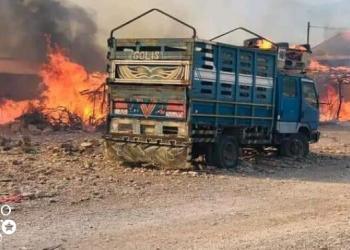
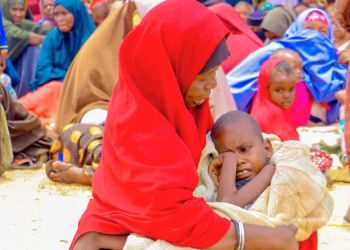
They were among 149 internally displaced families mostly living in the only IDP camp in Badhan given purpose-built houses. They fled the village of Markad, 45 kilometres to the east, where conflict broke out between Al-Shabab and Puntland forces in February 2021.
Ahmed in fact had not managed to find space in the IDP camp to put up a hut, so he was renting a house outside for $30 a month. He relied on $100 sent by his nephew every month to pay rent and other basics for the family.
“This house has relieved us of the rent we used to pay. We are people who have been displaced and we had to flee our homes,” he said.
Leaving the village left four of his children, who were respectively in grades six, seven and eight at Markad elementary and primary school, out of education, which is a great concern.
“Education is our biggest need at the moment. We have school-going children whose education was disrupted. We can’t leave them just to hustle in the market, if we do so they will be left behind by their age mates,” he declared.
The houses were built by the Danish Refugee Council (DRC), who also gave families household utensils and jerry cans to store water. Ahmed and his children go to fetch water from Badhan, five kilometres from their new home, carrying the 20 litre jerry cans on their backs. The area where the houses have been built has neither water sources nor toilets.
“At night, people can relieve themselves in those open fields, but during the day you have to walk to the bushes, which is far. The elders can’t even walk as far away as that,” he complained.
Back home in Markad village, Ahmed and other like him was an independent farmer harvesting twice a year and making more than $1,500 from the sale of produce from his one and a half hectare farm. He was also able to put aside food from the harvest for his family to eat.
“We worked hard and depended on our farm produce. We used to sell our harvest as far away as Bossaso. When the fighting began, we fled. We were farmers for 40 years and we haven’t been able to adapt to life in the town,” he said.
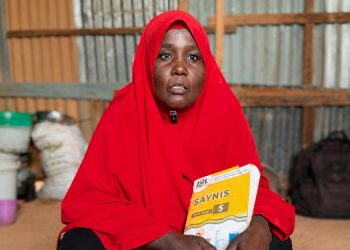
Hawo Ali Farah, a pastoralist with 40 goats in Markad, fled the conflict leaving behind her herd, her house, and her small butchery business. Her family of seven were staying with a relative in Badhan. Hawo told Radio Ergo that she is glad to have been given a house of her own now.
“I felt I was a burden on my host family for so long. They couldn’t cook their little food and eat in peace, as I and my family were around, with nothing. But now, I am glad that I am sleeping in my own home,” she said.
Hawo cooks two meals a day with whatever her two eldest sons earn at a stone quarry.
“We depend on the boys for a living. We eat when they come back with money, if they don’t, we sleep hungry. The women here have nowhere to go for work, there is unemployment,” she said.
She would like to get her goats back if she goes home to the village. She urged Badhan district administration and aid agencies to create job opportunities for them for the time being.
The district administration, which played a role in selecting the families, gave title deeds to the recipients. Badhan district commissioner, Ahmed Mohamed Timir, said they are working with aid organisations to establish water points and schools over the next three months.
Sporadic fighting is ongoing in the Al Madow mountain range around Markad that comes under Puntland authorities. The Badhan district administration said it will be up to the families themselves to decide if they return or not.