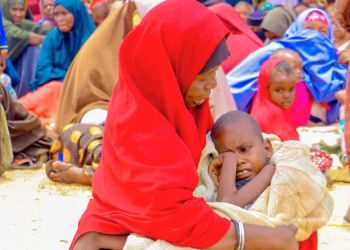


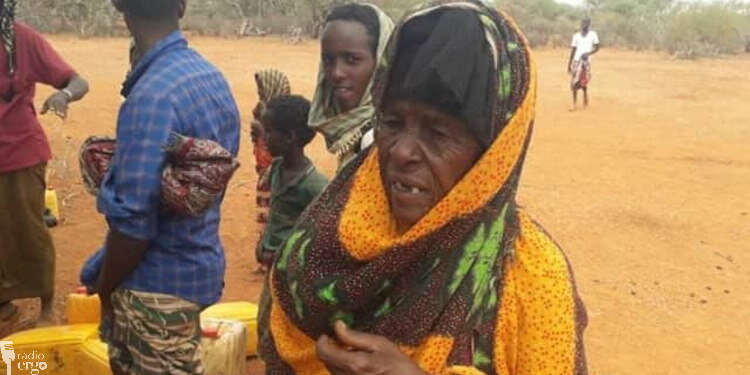
(ERGO) – Left behind by her husband and eldest son with nine young children in Washaqo village, on the border between Somalia’s Bakool region and southern Ethiopia, Sahan Abdi Gas has been watching her food supplies dwindle and wondering how many more meals she will be able to cook for the children.
They are sleeping out under a tree, where she has strung some items of clothing from the branches to make a rudimentary shelter.
She told Radio Ergo that she thinks there are up to 200 families like hers, comprising of women, children, and the elderly, camped out in this village in Radhure, whilst the men and older boys have crossed into Ethiopia’s Somali Region hoping to find water and pasture for their remaining livestock.
“I don’t sleep at night worrying about the hardship we are living in and the lack of information from those who are away [her husband and son]. I am unable to reach them because the area they went to doesn’t have phone network. I haven’t heard from them since they left 20 days ago,” she said.
Sahan’s husband and son separated from them in Washaqo and crossed the border into Afder zone, where there has been rainfall, with the family’s remaining 21 camels. The children and their last seven goats would have been unable to make the journey, so they had stayed behind.
Before arriving in Washaqo on 26 November, they had all walked together for a day and a night the 26 kilometres from the village of Dirihley in Bakool, where the water reservoirs had all dried up and 90 of their goats had died.
Sahan told Radio Ergo that they managed to sell four of the remaining seven goats and bought 62 kgs of rice, sugar and sorghum with the 900,000 Somali shillings from the sale. Nobody wanted to buy the last three goats that are too sickly. Since the men have gone, they have been living on this food, but when the last two kilos have gone she does not know what she will do.
“We are in a dire situation and it is all God’s will,” she said.
At least Washaqo has a well that can provide enough water for the people, which is why the families settled there. Sahan says they fetch water on their backs, although they have to pay 1,000 Somali shillings for 20 litres.
Mohamed Rashid Maalim, another pastoralist, migrated with his livestock from Bananey village, not far from Dirihley, with 140 goats and 27 camels trying to save them. They headed for a rural part of Hudur district 180 kilometres away, where they heard there had been rainfall. However, during the five days travelling Mohamed lost 70 goats. When they finally reached their destination, they found many others had already arrived and the little grass and water had all gone.
“A lot of pastoralists have converged on the area hoping to get pasture, but now we are all stuck. We are on the move again. We are headed to a place that received rainfall near Baidoa,” he said.
Mohamed is migrating with his livestock alone. His wife and five children fled to Washaqo on 29 November and are being hosted by a relative who lives there. He contacts his family by phone, but he is unable to send them any money as he has nothing himself and the livestock have no market value.
“We take the livestock to the market but there is no one to buy them. You can understand how painful it is to leave your wife and children in a far-flung area and you can’t support them in paying the bills. It is really very painful,” he said.
Some of the families who fled to Washaqo have lost their entire herds of livestock to the drought and had been depending on other pastoralists for support.
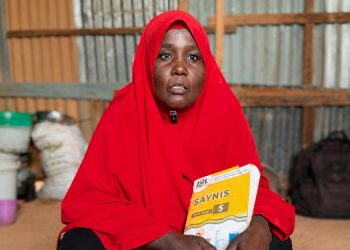
Adar Maalin, a widowed mother of six, lost all her 49 goats in August and was depending on support from her pastoralist neighbour in Dhanawe village, 30 km from Washaqo. However, the family helping them have now moved away with their livestock in search of pasture. Adar is now cooking her children one meal a day, which is donated to her by the local residents.
“I am sheltering under a tree and we cook whatever little we get from the locals here in the evening. We came here so that we could just get water to drink,” she said.