Radio Ergo - Somali Humanitarian News and Information
  • Home
  • Topics
    • Latest Stories
    • IDPS/Refugees
    • Natural Disasters
    • Health
    • Social
    • Food Security
    • Education
    • Agriculture & Livestock
  • Programmes
    • Locust Programme
    • Farming Programme
    • Radio Doctor Programme
    • Women Programme
    • Entertainment Programme
  • About Radio Ergo
  • Contact Us
  • blankSomali
  • blankEnglish
No Result
View All Result
Radio Ergo - Somali Humanitarian News and Information
  • Home
  • Topics
    • Latest Stories
    • IDPS/Refugees
    • Natural Disasters
    • Health
    • Social
    • Food Security
    • Education
    • Agriculture & Livestock
  • Programmes
    • Locust Programme
    • Farming Programme
    • Radio Doctor Programme
    • Women Programme
    • Entertainment Programme
  • About Radio Ergo
  • Contact Us
  • blankSomali
  • blankEnglish
No Result
View All Result
Radio Ergo - Somali Humanitarian News and Information
Home LATEST STORIES

Water woes befall families in Somali coastal town in Mudug

Radio Ergo by Radio Ergo
July 20, 2020
in LATEST STORIES, NATURAL DISASTERS, SOCIAL
0
blank

Photo file/Ergo

0
SHARES
Share on FacebookShare on Twitter

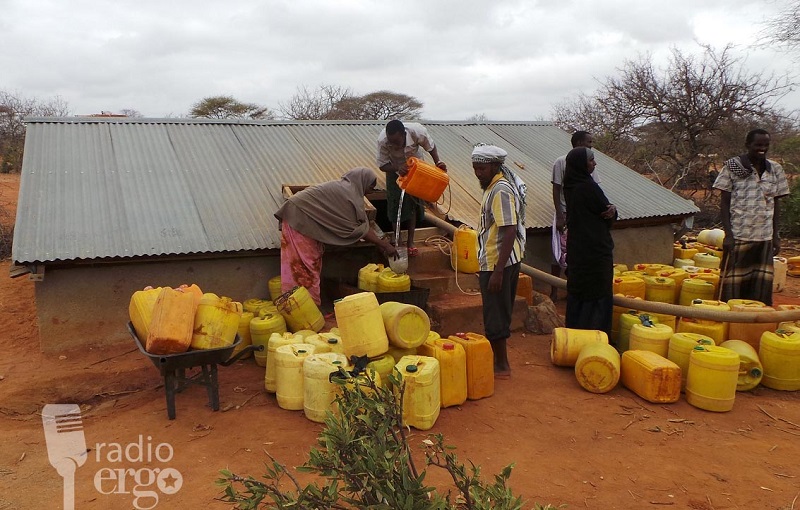
(ERGO) – Residents in Elhur, 70 km north of Harardher city in Mudug region, are waiting for a solution to their water woes.

Dahabo Hassan Mohamud, a mother of 12, told Radio Ergo that profit margins at her tea shop have fallen due to the high cost of water, since the road to their usual well became blocked by sand.

“I have to buy a barrel or a barrel and a half a day, spending up to $7, which means some days I don’t make any profit at all,” she said. “I have been selling tea for 15 years, and I only make about $4 a day, which barely caters for our needs.”

“It’s the only business I know and I don’t have alternatives, so during tough times like this, I have no choice but to live on credit,” Dahabo said.

The trucks that normally ferry water cheaply from the nearest well 18 km from town are unable to make the journey due to the blocked road.

The well manager, Abdulqadir Mohamud Hussein, told Radio Ergo they had been planning to pipe water to the town but the survey was interrupted by the Coronavirus pandemic.

“The project engineer could not come here due to the Coronavirus travel restrictions,” he said. “I hope the survey will resume soon and afterwards the piping can begin.”

For now, merchants bring water on donkey carts from hand-dug wells three kilometres away, but the prices are more than most residents can afford.

Mahad Abdullahi Ahmed, a resident, told Radio Ergo that he has resorted to carrying water on his back about three times a week.

“I fill up my jerrycans and I carry them myself for the family. I bring about three jerrycans each time and the family uses this in a day or two,” he said.

Abdiqadir Mohamed Awale, a local elder, said people are digging wells by hand but the water is not reliable because of the proximity to the sea.

“The water merchants call on their friends to help them dig new wells, then the water turns saline after extracting just a few barrels of water, so they have to dig another one,” he said. “This is not sustainable, it’s just a stop-gap measure.”
Previous Post

Rain brings tragedy to IDP family in Mogadishu camp

Next Post

Health expert answers listeners’ questions on COVID 19 (15)

Related Posts

IDP families kicked off Baidoa land lose their assets, income, schools, and health centre
FOOD SECURITY

IDP families kicked off Baidoa land lose their assets, income, schools, and health centre

September 10, 2026
Lower Shabelle breadbasket farms become a hunger belt for local families
AGRICULTURE & LIVESTOCK

Lower Shabelle breadbasket farms become a hunger belt for local families

September 8, 2026
Drought-hit Lower Juba pastoralists flee towards the Somali-Kenyan border
FOOD SECURITY

New Kismayo settlement has schools and healthcare for IDPs – but no jobs for income

September 3, 2026
blank
FOOD SECURITY

Tax rise in Somaliland puts poor Hargeisa shop owners out of business

September 2, 2026
blank
FOOD SECURITY

New tax halts lifeline work for displaced sand transporters in Baidoa

August 29, 2026
blank
FOOD SECURITY

Impoverished pastoralists in Mudug flee to resource-poor camps in Galkayo

August 28, 2026
Next Post
Radio Doctor

Health expert answers listeners’ questions on COVID 19 (15)

FOLLOW US ON FACEBOOK

DAILY PROGRAMMES

IDAACADDA 10-SEP-2026

IDAACADDA 10-SEP-2026 by Radio Ergo

IDAACADDA 10-SEP-2026
Episode play icon
IDAACADDA 10-SEP-2026
September 10, 2026
Episode play icon
IDAACADDA 09-SEP-202
September 9, 2026
Episode play icon
IDAACADDA 08-SEP-202
September 8, 2026
Episode play icon
IDAACADDA 07-SEP-2026
September 7, 2026
Episode play icon
IDAACADDA 06-SEP-2026
September 6, 2026
Search Results placeholder
Radio Ergo Weekly Newsletter
We respect your privacy.
blank
blank
blank

© Copyright 2014 - 2024 Radio Ergo

No Result
View All Result
  • Home
  • Topics
    • Latest Stories
    • IDPS/Refugees
    • Natural Disasters
    • Health
    • Social
    • Food Security
    • Education
    • Agriculture & Livestock
  • Programmes
    • Locust Programme
    • Farming Programme
    • Radio Doctor Programme
    • Women Programme
    • Entertainment Programme
  • About Radio Ergo
  • Contact Us
  • blankSomali
  • blankEnglish

© Copyright 2014 - 2024 Radio Ergo