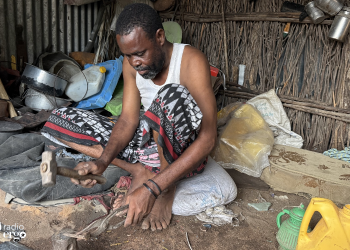


(ERGO) – Old tyres are in high demand in parts of central Somalia’s Galgadud region, as farmers prepare to fight with whatever means they have available against another locust invasion that threatens to be devastating.
Farmers have started buying up used tyres to burn to smoke the locusts away. This has made tyres a valuable commodity in Guriel and other cities in Galgadud, where used tyres that used to be free are now selling for two or three dollars apiece.
Yolah Ali Hashi, who owns a four-hectare farm in Labihalul on the outskirts of Guriel, told Radio Ergo that he is taking measures to prevent a repeat of last season, when swarms of locusts destroyed his crops, including onions, beans, watermelon and lemon.
This time he is preparing early in the planting season.
“In the last invasion we used honks of car horns and drumming of cooking pots and pans to ward off the locusts. This time we plan to use whistle blowers and burning tyres,” he said.
Yolah is still reeling from the losses he incurred in the last invasion. The farm is his only source of livelihood. He feeds and pays for the education of his 12 children with the income he generates from the farm.
Experts have warned that another wave of desert locusts is likely to strike East Africa after a period of breeding.
Ali Dahir Arabey, whose two-hectare farm near Dhusamareb was destroyed in the last locust invasion, told Radio Ergo that it is futile for a single farmer to fight the locusts. The farmers need to unite or everything will be lost again.
“We need to help each other in this fight. We should come together in groups; some should be burning tyres while others should be creating noise by blowing whistles,” he said.
Three members of Ali Dahir’s family were poisoned last time the locusts came, after they mixed chemicals intended to kill ticks on livestock as a spray against the locusts. They recovered from the nasty effects, but the experience has taught Ali Dahir a lesson.
“We were so focused on fighting the locusts that we used dangerous poisons that affected our health,” he said.
Abdiqadir Jimale Mahamud, an agriculture expert, told Radio Ergo that the best way to fight the locusts is to spray them from the air using crop-dusting
planes. However, in the absence of such planes and equipment, community mobilisation is key.
“When farmers see swarms of locusts coming, all the people should come out and create as much noise as possible to prevent them from landing and leaving behind their eggs. The next community should mobilize and use the same tactic, until the locusts are forced out of the entire area,” he said.