Radio Ergo - Somali Humanitarian News and Information
  • Home
  • Topics
    • Latest Stories
    • IDPS/Refugees
    • Natural Disasters
    • Health
    • Social
    • Food Security
    • Education
    • Agriculture & Livestock
  • Programmes
    • Locust Programme
    • Farming Programme
    • Radio Doctor Programme
    • Women Programme
    • Entertainment Programme
  • About Radio Ergo
  • Contact Us
  • blankSomali
  • blankEnglish
No Result
View All Result
Radio Ergo - Somali Humanitarian News and Information
  • Home
  • Topics
    • Latest Stories
    • IDPS/Refugees
    • Natural Disasters
    • Health
    • Social
    • Food Security
    • Education
    • Agriculture & Livestock
  • Programmes
    • Locust Programme
    • Farming Programme
    • Radio Doctor Programme
    • Women Programme
    • Entertainment Programme
  • About Radio Ergo
  • Contact Us
  • blankSomali
  • blankEnglish
No Result
View All Result
Radio Ergo - Somali Humanitarian News and Information
Home AGRICULTURE & LIVESTOCK

Pastoralists in central Somalia’s Mudug sell off their last animals and move to towns

Radio Ergo by Radio Ergo
January 15, 2020
in AGRICULTURE & LIVESTOCK, LATEST STORIES
0
Pastoralists in central Somalia’s Mudug sell off their last animals and move to towns

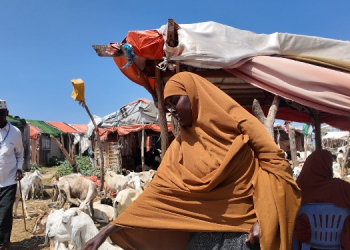
Pastoralists selling off their last herds in Galkayo market/Jabril Osman/Ergo

0
SHARES
Share on FacebookShare on Twitter

(ERGO) – Many pastoralist households in the Mudug region of central Somalia are giving up their traditional livelihoods to settle in urban areas, after finding it unsustainable in the face of recurrent drought.

Three days ago, Abdi Dahir Hussein brought eight goats, the last of the 20 goats he owns, to sell at Galkayo livestock market.

“I’ve decided to sell off my herd because this way of life is becoming impossible. I intend to become a labourer in the nearby town,” he said.

Abdi, a father of eight children, lost dozens of his livestock in the last drought. This forced him to move to El-aqwan area near Galkayo to consider his dwindling options.

“The money I get from selling my last remaining herd would not be enough to start a business. I borrowed $1,000 before to cater for my basic needs, so whatever I make now would go towards that and to cover our basics needs,” he said.

There appears to be an escalation in rural to urban migration, as a result of the prolonged drought and hardships. Pastoralist drop-outs tend to move first to areas near small towns to tend their remaining animals, while looking for other options. Each household would have a maximum of 40 animals, usually far less. They use the small monies they earn from selling off their animals to rent houses, open small kiosks and send their children to school.

Livestock traders in Galkayo told Radio Ergo that the prices for live animals have fallen due to the over-supply of animals in the market.

According to Abdi Salad Ahmed, a livestock trader in south Galkayo, the best price that a prime goat can fetch nowadays is $60.

“These pastoralists used to own hundreds of animals and now they have very few. They have been pastoralists all their lives with no other skills and now they’re struggling on the outskirts of town with less than a dozen animals,” he said in empathy.

He added that in the 14 years he has been a livestock trader in Galkayo, he has never seen so many pastoralists choosing to sell off their entire herds and abandon their traditional way of life.

Abdi Osman Ahmed, 85, has decided to sell off his last 15 goats for only $300.

“I was in need and had no support whatsoever. My animals have been decimated in the last drought, so I did not want to wait to lose these ones too,” he explained.

Before the drought, he owned over 250 animals, most of which he inherited from his father. He told Radio Ergo that at his age he is done with pastoralism and is now seeking the support of relatives and hopes to focus on educating his offspring.

Abdi Ali Hashi, 50, a former pastoralist now trading livestock in Galkayo, told Radio Ergo that he is worried about the increasing number of pastoralists dropping out. He believes that instead of selling off their entire herd and moving to urban centres, they should learn to function in both worlds as previous generations used to do.

“Previously, pastoralists would tend to their animals and occasionally bring a small herd to the market and then buy the supplies they need from urban areas. I hope these pastoralist drop-outs might learn to persevere somehow,” he said
Previous Post

Dadaab refugee students desperate for overseas scholarships repeat high school exams

Next Post

Locusts add to the woes of Somali farmers in flood-hit Hiran region

Related Posts

Baidoa farmers reap benefits of climate knowledge and irrigation
AGRICULTURE & LIVESTOCK

Baidoa farmers reap benefits of climate knowledge and irrigation

May 11, 2026
Clamour for enacting new rape bill as high numbers of rapes are reported in Somaliland
FOOD SECURITY

Harrowing tales of family ruin as courts throw debtors into jail in Galkayo

May 9, 2026
Somalia live news, Somalia latest news, Mogadishu live news, Somali news
FF Feedback

Radio Ergo audience feedback report 30 April to 6 May 2026

May 8, 2026
Floods swamp Somali Region salt mines leaving hundreds in distress
FOOD SECURITY

Floods swamp Somali Region salt mines leaving hundreds in distress

May 8, 2026
Women pushing heavy loads support displaced families in Mogadishu
FOOD SECURITY

Women pushing heavy loads support displaced families in Mogadishu

May 6, 2026
Hiran Farmers find relieve in Solar Power
AGRICULTURE & LIVESTOCK

Solar irrigation enables Jubbaland farmers to harvest again

May 5, 2026
Next Post
Locusts add to the woes of Somali farmers in flood-hit Hiran region

Locusts add to the woes of Somali farmers in flood-hit Hiran region

FOLLOW US ON FACEBOOK

DAILY PROGRAMMES

IDAACADDA 11-MAY-2026

IDAACADDA 11-MAY-2026 by Radio Ergo

IDAACADDA 11-MAY-2026
Episode play icon
IDAACADDA 11-MAY-2026
May 11, 2026
Episode play icon
IDAACADDA 10-MAY-2026
May 10, 2026
Episode play icon
IDAACADDA 09-May-2026
May 9, 2026
Episode play icon
IDAACADDA 08-MAY-2026
May 8, 2026
Episode play icon
IDAACADDA 07-MAY-2026
May 7, 2026
Search Results placeholder
Radio Ergo Weekly Newsletter
We respect your privacy.
blank
blank
blank

© Copyright 2014 - 2024 Radio Ergo

No Result
View All Result
  • Home
  • Topics
    • Latest Stories
    • IDPS/Refugees
    • Natural Disasters
    • Health
    • Social
    • Food Security
    • Education
    • Agriculture & Livestock
  • Programmes
    • Locust Programme
    • Farming Programme
    • Radio Doctor Programme
    • Women Programme
    • Entertainment Programme
  • About Radio Ergo
  • Contact Us
  • blankSomali
  • blankEnglish

© Copyright 2014 - 2024 Radio Ergo