Radio Ergo - Somali Humanitarian News and Information
  • Home
  • Topics
    • Latest Stories
    • IDPS/Refugees
    • Natural Disasters
    • Health
    • Social
    • Food Security
    • Education
    • Agriculture & Livestock
  • Programmes
    • Locust Programme
    • Farming Programme
    • Radio Doctor Programme
    • Women Programme
    • Entertainment Programme
  • About Radio Ergo
  • Contact Us
  • blankEnglish
No Result
View All Result
Radio Ergo - Somali Humanitarian News and Information
  • Home
  • Topics
    • Latest Stories
    • IDPS/Refugees
    • Natural Disasters
    • Health
    • Social
    • Food Security
    • Education
    • Agriculture & Livestock
  • Programmes
    • Locust Programme
    • Farming Programme
    • Radio Doctor Programme
    • Women Programme
    • Entertainment Programme
  • About Radio Ergo
  • Contact Us
  • blankEnglish
No Result
View All Result
Radio Ergo - Somali Humanitarian News and Information
Home AGRICULTURE & LIVESTOCK

LIVESTOCK DYING THROUGH LACK OF AWARENESS ABOUT VETERINARY MEDICATION

admin by admin
August 8, 2016
in AGRICULTURE & LIVESTOCK
0
LIVESTOCK DYING THROUGH LACK OF AWARENESS ABOUT VETERINARY MEDICATION

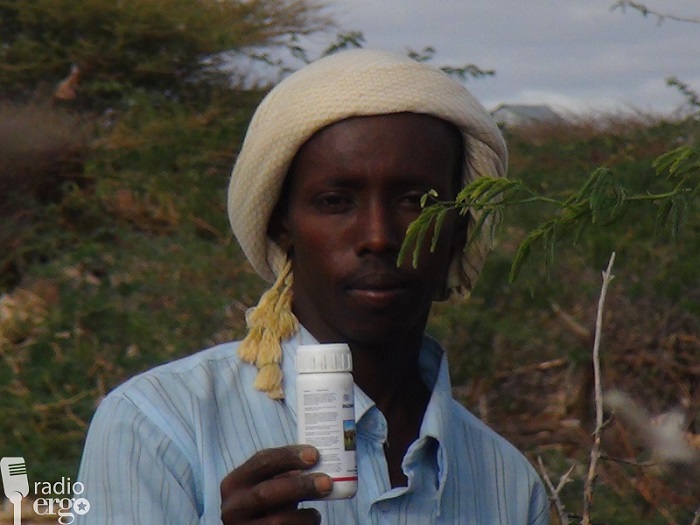
Photo | Abdikani with the medicine he applied to his goats/NafisoOogle/Ergo

0
SHARES
Share on FacebookShare on Twitter

(ERGO) – Abdikani Sheikh Elmi lost 98 of his goats a month ago after applying veterinary chemicals to his herd to get rid of ticks. He had not diluted the liquid according to the instructions and the strength of the dose killed almost all his animals.

“I heard strange noises coming from where the goats were after half an hour of putting the medicine on them. I went back to check it out and I saw all the goats lying dead except two,” Abdikani told Radio Ergo.

He had mixed the chemical with the amount of water he thought would be enough to treat all of his goats and sprayed it on them.

Such cases of lack of knowledge of the correct way to use veterinary medicines are far from uncommon in this part of Somalia. This has led to the deaths of large numbers of livestock.

Radio Ergo’s reporter in Dhusomareb took a picture of the bottle of the chemical used and showed it to a member of the regional veterinary association, Suleiman Salah. The drug in question was Diazinon, prescribed to deal with external parasites. The drug was introduced to Somalia in late 2015 replacing other drugs that had been phased out.

According to the Suleiman, many herders were not aware of the correct way to dilute the medicine. He advised pastoralists to make sure they got someone else to read the instructions if they could not read themselves.

Abdikani admitted that he had no knowledge of the correct dosage to use. “The fact that the drug was in a small plastic bottle and the goats were very many was the basis of my measurement. I did not bother to know if the drug was to be used in a small quantity or not,” he said.

In May, Abdi Farah Ahmed from Gal-qoryale village, 75 km from Dhusamareb, used the same chemical without diluting it properly and lost 100 of his 120 goats.  He had borrowed the medicine from his neighbour who bought it from a local pharmacy.

Abdi’s livelihood selling goats in Guriel market has suffered and his family is now getting support from relatives as he is unable to provide enough for them.

Suleiman told Radio Ergo he knew of three similar cases over the past three months in remote villages in Guriel district and in Balliad location, 50 km from Dhusamareb.
Previous Post

BANANA CROP DECIMATED BY DROUGHT IN SOUTHERN SOMALIA’S AFGOYE

Next Post

DHOBLEY FARMERS SEE BENEFIT OF WATER CONSERVATION

Related Posts

Solar irrigation doubles production and cuts costs for Afgoye farmers
AGRICULTURE & LIVESTOCK

Solar irrigation doubles production and cuts costs for Afgoye farmers

September 18, 2026
blank
AGRICULTURE & LIVESTOCK

Wild animal invade fenceless farms in Togdher ruining families’ crops and incomes

September 16, 2026
Lower Shabelle breadbasket farms become a hunger belt for local families
AGRICULTURE & LIVESTOCK

Lower Shabelle breadbasket farms become a hunger belt for local families

September 8, 2026
Livestock diseases decimate Galgadud herds and destroy livelihoods
AGRICULTURE & LIVESTOCK

Livestock diseases decimate Galgadud herds and destroy livelihoods

August 14, 2026
Sudden flooding sets back the hopes of returnee farmers in Marka, Lower Shabelle
AGRICULTURE & LIVESTOCK

Isolated Juba farmers want help repairing broken riverbanks that lead to constant flooding

August 5, 2026
Pests and disease lay waste to family farms in western Somaliland’s Salil region
AGRICULTURE & LIVESTOCK

Combination of locusts and water shortage devastate Mudug farmers

July 15, 2026
Next Post
DHOBLEY FARMERS SEE BENEFIT OF WATER CONSERVATION

DHOBLEY FARMERS SEE BENEFIT OF WATER CONSERVATION

FOLLOW US ON FACEBOOK

DAILY PROGRAMMES

IDAACADDA 28-SEP-2026

IDAACADDA 28-SEP-2026 by Radio Ergo

IDAACADDA 28-SEP-2026
Episode play icon
IDAACADDA 28-SEP-2026
September 28, 2026
Episode play icon
IDAACADDA 27-SEP-2026
September 27, 2026
Episode play icon
IDAACADDA 27-SEP-2026
September 27, 2026
Episode play icon
IDAACADDA 25-SEP-2026
September 25, 2026
Episode play icon
IDAACADDA 24-SEP-2026
September 24, 2026
Search Results placeholder
Radio Ergo Weekly Newsletter
We respect your privacy.
blank
blank
blank

© Copyright 2014 - 2024 Radio Ergo

No Result
View All Result
  • Home
  • Topics
    • Latest Stories
    • IDPS/Refugees
    • Natural Disasters
    • Health
    • Social
    • Food Security
    • Education
    • Agriculture & Livestock
  • Programmes
    • Locust Programme
    • Farming Programme
    • Radio Doctor Programme
    • Women Programme
    • Entertainment Programme
  • About Radio Ergo
  • Contact Us
  • blankEnglish

© Copyright 2014 - 2024 Radio Ergo