

(ERGO) – The introduction of charges for water that should be free has caused displaced families living in a camp in central Somalia’s Mudug region to go short of water and food, after a borehole improvement plan went awry.
Diaspora donors raised $17,000 to drill a new borehole for families in Khay-door IDP camp near Ba’adweyn. But as drilling costs proved too high due to the hard terrain in Mudug, the money was used instead to improve an existing privately owned borehole in Ba’adweyn.
The borehole owners agreed they would supply water for free to the IDPs via a pipeline to the camp in exchange for the financial investment.
However, in December the borehole owners reneged on their agreement and since then have been charging the IDPs for their water supply in the camp.
Residents say the combined pressure of the new fees for water, coinciding with cuts in aid, have left many families unable to afford enough food or safe drinking water.
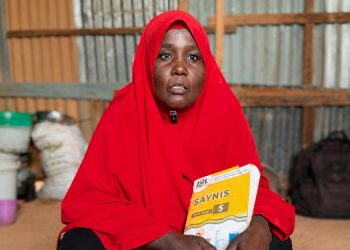
Jama Mahmoud Muse, a father of 12, said his family had been unable to secure regular meals or water.
He told Radio Ergo that the family survives on one small meal a day, occasionally helped by relatives living in Ba’adweyn town. They have to pay $1.3 for a 20-litre jerrycan from the pipeline. They can’t afford the cost and the water is also salty and hard to drink.
“We are very vulnerable people. Out of three meals a day we only manage one. The water supply was cut off because I couldn’t pay the $1.3, and the debt I owe has built up for four months. We have no livestock and no jobs,” Jama said.
During their two years in the camp, Jama’s family depended largely on humanitarian assistance. But the last aid he received was through a food aid card from the UN’s World Food Programme (WFP), which provided about $75 per month. The cash ended in the middle of 2025.
Since then, he has accumulated about $300 in debt after buying food on credit from shops in Ba’adweyn. Shopkeepers have now refused him further credit and are pressing him to repay what he owes.
He fears the worsening food shortages could lead to malnutrition among his children. The family’s financial struggles have also disrupted their education. Four of Jama’s children dropped out of school this year after he failed to pay their monthly fees of $35 at a local primary school in Ba’adweyn.
“Some of my children had reached the seventh and eighth grades, but they had to leave school. They used to go to the town for their lessons, but recently they were sent away because we couldn’t pay the fees.”
Jama’s family was displaced in 2023 from rural areas near Gallaadi in Ethiopia’s Somali Region after drought killed the last of his 70 goats that had sustained their livelihood.
Relatives advised him to move to Ba’adweyn in the hope of receiving humanitarian aid, but assistance began declining soon after his arrival.
Although he has no skills beyond pastoralism, Jama walks 10 kilometres to Ba’adweyn town most mornings searching for casual work and occasionally makes $5 unloading trucks.
Other displaced residents in Khayr-door camp are facing similar hardships.
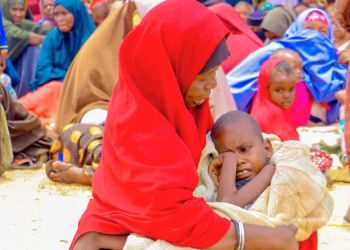
Sirad Mahmoud Dalmar, a widow raising seven children, said she cannot provide enough food or water for her children and has been relying on small amounts of food and water from other camp residents.
“We have no food. This morning I made some plain flatbread with nothing to eat with it. The children are still waiting to see if we will find something for the evening,” she said.
Sirad has also accumulated debts of about $300 buying food and water on credit. The managers of the borehole pipeline cut her water supply in January, following months of unpaid bills.
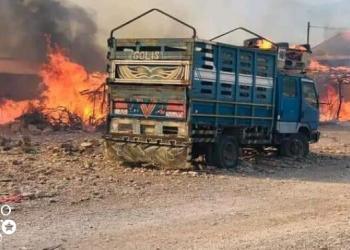
Sirad’s family lives in a hut made from torn cloth and plastic that collapsed some time ago. She has been unable to repair it. The family was displaced in 2017 from rural areas near Ba’adweyn after drought wiped out her herd of 30 goats.
Khay-door camp chairman, Abdiweli Ahmed Mohamed, said the decision by the borehole owners to charge for water had worsened conditions for the 476 families living in the camp.
Attempts by Radio Ergo to reach the borehole management for comment were unsuccessful.
The camp administration said they had raised the issue several times with those responsible for the water system but had received no response.
“People here have no proper shelter. Their huts are worn out and there are no replacements,” he said. “There is no health centre. Pregnant women and sick people have to be taken six kilometres to Ba’adweyn,” Abdiweli said, adding that more than 300 children had no access to education because there is no school nearby.