

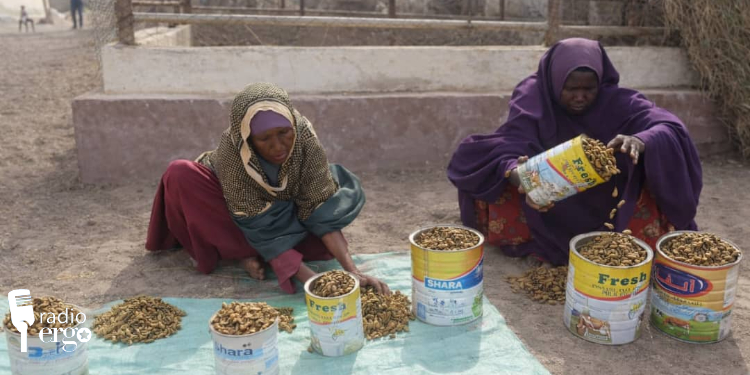
(ERGO ) – Before sunrise, groups of women leave the internal displacement camps on the outskirts of Kismayo, southern Somalia, to trek out together into the rural areas to the copses of acacia trees.
They harvest the seeds, locally known as abqo, that have become a good source of income for poor families, selling them for animal feed that is especially in demand during dry seasons.
For more than 100 displaced women in Kismayo, collecting and selling the seeds has become one of the few available livelihood options.
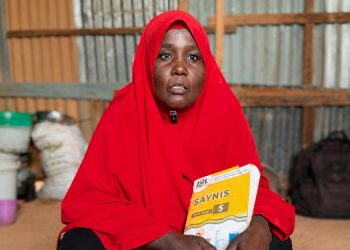
Abdiyo Hassan Ali, 55, a mother of eight, spends up to six hours a day walking to and from acacia-growing areas outside the town. She carries her seed harvest to a small market near Kismayo’s livestock holding ground, where traders buy them for resale to pastoralists.
“Sometimes I earn three dollars, sometimes four. From that money, I take one and a half or two dollars to the shop where we get our supplies and buy food. The rest goes on buying firewood and water. That is how I manage,” she said.
This mother and her family were displaced in November 2022 from Biyole village in Lower Juba, about 45 kilometres from Kismayo, after losing 80 goats and 15 cattle to drought.
Living now in Nasrudin displacement camp, selling the seeds has improved their situation since she began three months ago, after a period marked by hunger and lack of schooling for her children. Her income enables her to provide more regular meals. She has enrolled four of her children in a local primary school, including two girls under the age of 10.
To cover school fees totalling $20, she sets aside about five dollars each week. Having some income has helped her establish trust with local shopkeepers, who now allow her to buy food on credit when her income is low.
Selling acacia seeds is a seasonal trade, with prices fluctuating depending on supply and demand. The seeds are measured and sold in recycled containers, including milk tins, which serve as standard units in the market.
“There is a whole market just for acacia seeds,” Abdiyo told Radio Ergo. “People sell according to their luck. Those affected by drought buy from us and take the seeds back to the rural areas. A milk tin of acacia seeds sells for one dollar fifty. If it doesn’t sell, I reduce it to one dollar twenty-five.”
As the acacia trees are tall and difficult to harvest, the women work together in groups. They also travel collectively for safety, as the areas they pass through are remote and sparsely populated.
“We carry long sticks and shake the tree. Two people shake it, the abqo seeds fall, then we collect them and put them into sacks. This is the best season for acacia seeds. We are women and there are no men with us but God has protected us. We see nothing except monkeys,” she said.
Packs of monkeys frequently interfere, attempting to steal the women’s water and the harvested seeds.
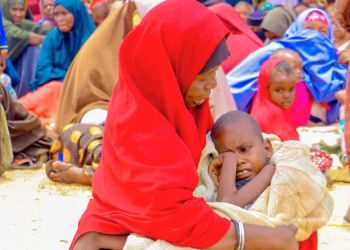
At the market near Kismayo’s livestock yard, dozens of women sit in rows under intense heat, waiting for buyers to purchase their sacks of acacia seeds. The market has become a meeting point for displaced women, whose livelihoods were wiped out by drought and displacement.
Fadumo Abdulle Hassan, 45, says the trade rescued her family from severe hardship. She supports three children on her own after separating from her husband. She began selling acacia seeds last September.
“Usually, we earn three dollars or three and a half,” she said. “We sell whatever we collect. We eat what God has written for us. If we get more, we eat more. If we get less, we buy food with what we have.”
Fadumo walks more than 20 kilometres into the bush, returning with two sacks of acacia seeds balanced on her head.
She lives in a makeshift shelter in Nasrudin displacement camp, where she moved after her small business selling homemade ice cream failed.
“If the ice cream you make today doesn’t sell by evening, it melts,” she said. “That made me leave the idea. But for the acacia seeds, if they don’t sell today, they won’t spoil, and you can ty to sell them again tomorrow.”
The acacia seeds trade has long been practised in rural areas, but displaced women say it has become more important as food aid in Kismayo’s camps has declined, leaving women forced to find alternative ways to survive.