

(ERGO) – Nearly 2,000 families are facing hunger and lack of water in villages in Alula district, after two devastating failed rainy seasons across Puntland, including in the far northernmost tip of Bari region.
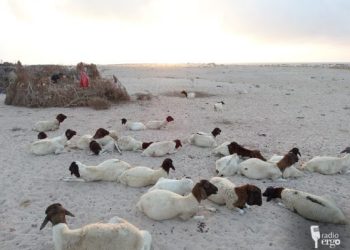
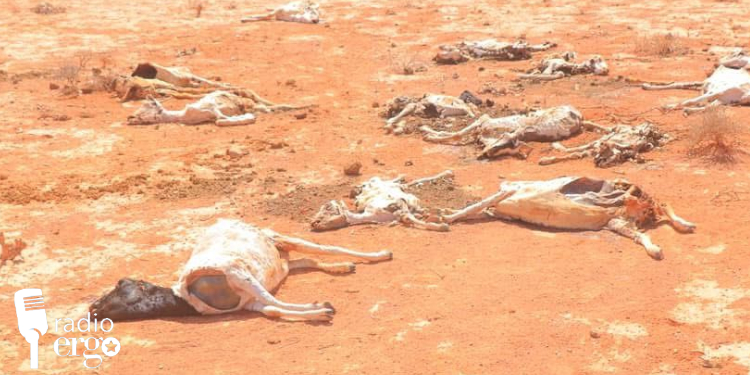
The prolonged drought has forced families to abandon their homes and livelihoods, triggering widespread displacement and humanitarian distress. Many animals have perished and their carcasses lie grimly on the dry ground.
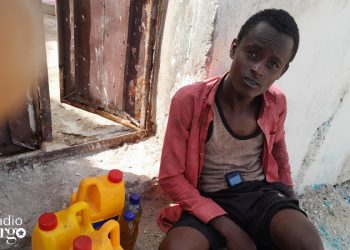
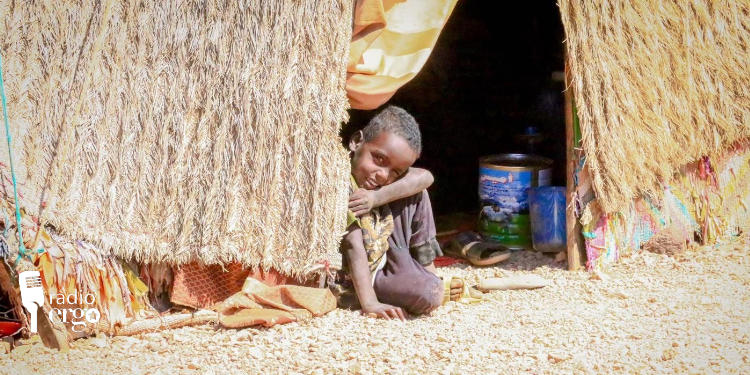
Children from displaced households are among the hardest hit, facing disease outbreaks and prolonged disruption to their education. Families who relied on livestock in Tohin, Muranyo, Haabo, and Bareeda now struggle to meet even the most basic daily needs.
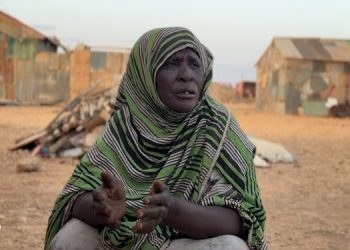
Astur Mohamed Hassan, a mother of nine, is one of those grappling with the impact of the drought. She currently lives in Muranyo area in Puntland’s Bari region, where she arrived at the end of November after losing most of her livestock.
Astur said her family depended entirely on livestock for survival, but severe drought wiped out 71 goats out of the 100 they owned. The remaining 29 animals are weak and no longer productive, with no milk or meat to sustain the household.
Her family now relies on irregular food and water assistance from the relatives and locals in the area, although the nearest household is a 25-minute walk away.
“Sometimes I go to relatives. If food is cooked in the morning, that is what we get for the whole day. If nothing is cooked at night, we sleep hungry. There are days you find food but no water, and other days you beg for water but cannot find food,” Astur said.
She added that the animals she has left offer little hope, as the area lacks adequate grazing land to keep them healthy.
This mother and her family are among around 400 other pastoralist families displaced from Galgala village, about 15 kilometres from Muranyo.
Astur said she moved hoping to get better living conditions, although water prices remain unaffordable, with a single barrel costing between $8 and $10.
“We cannot afford water. Camels are sent to Muranyo, leaving in the morning and returning at night. The last water we got was on credit. Water is life – even if you get food, without water you cannot survive,” she said.
Astur is also burdened by a debt of about $500 accumulated over the past three months for food, water, and medicine. Creditors now regularly demand repayment.
With a household of 11 people, Astur has no one to earn income for the family. Her 63-year-old husband has been bedridden for three years due to chronic illness and has not received treatment due to poverty.
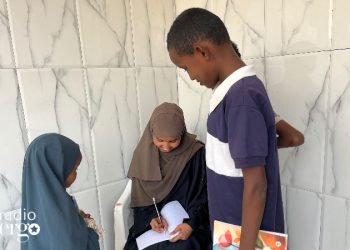
None of her children are currently attending school. Primary education at Geesaley school costs $20 a month that she cannot afford.
Another displaced resident, Abdishakur Said Mohamed, moved to Geesalay after losing 78 animals to drought last December. His family of 12 currently lives in a two-room house he built earlier in the area.
“Today, whoever finds one meal a day is considered fortunate. People only rely on relatives and neighbours. Water is unaffordable, and everyone here is facing the same hardship,” he said.
After displacement, Abdishakur attempted to earn income through fishing, hoping to support his family and repay a $300 debt. However, he said the effort failed as fish stocks near the coast have declined due to irregular and uncontrolled trawling.
“In the past, a worker could earn about $10 a day from fishing. Now, I don’t even earn one dollar,” he said, adding that repeated failure left him deeply discouraged.
As a result, Abdishakur withdrew five of his children from school in December after failing to pay $20 monthly fee per child.
“My livestock died in the drought, and fishing also failed. Now I struggle just to find daily food. In the evenings, I teach my children the Koran at the mosque so they are not completely without learning,” he said.
Education remains one of the most pressing challenges for these families. Abdishakur said that while five of his children remain at home, he teaches them basic religious lessons, as he cannot afford the $100 total fees per month.
The governor of Raas Aseyr region, Osman Said, has declared a humanitarian emergency, warning that conditions are rapidly deteriorating.
He told Radio Ergo that 89 water catchments have dried up, six boreholes are critically low, and four wells have become saline. Livestock deaths are increasing, food shortages are worsening, disease outbreaks are spreading, and schools are closing.
“The drought has affected all five districts equally. Rural families are moving into towns. Children are being hospitalised with diarrhoea, and food shortages are severe. People are fleeing to areas to find water,” the governor said.
He warned that without urgent humanitarian assistance, the situation could escalate into famine and widespread despair.