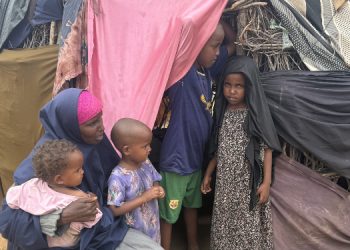


(ERGO) – When Hindiya Nuh Aalin watches her two eldest children sit idle outside their small hut in Alla-Amin camp on the outskirts of Galkayo, she says she feels a heavy heart.
The children, who should have joined secondary school this year, have been at home since September because their mother can’t pay the fees.
“When they were learning, I was so happy. Now that they’ve reached a higher level, the lack of resources has forced them to stop. It breaks my heart. They ask me every day to take them to school, but I can’t. Even finding something to light the fire for cooking is already difficult,” Hindiya told Radio Ergo.
Children from more than 150 families in Alla-Amin, Donyaale, Bulo-Agoon, and other displacement camps around Galkayo are unable to continue to secondary school this year.
Most families have no income to cover the monthly fees of $20 per child, nor the daily transport cost of $3 for schools located in the town. The camps is almost an hour’s walk from Galkayo, making the journey impossible for many children.
In Alla-Amin, the primary and middle school run with the support of Puntland’s Ministry of Education allowed hundreds of displaced children to study for free. But the absence of a free secondary school in or near the camp has created a dead-end for them now.
Hindiya’s household survives on scrap metal she scavenges from waste piles and sells in small quantities.
“I rely on metal I collect from the garbage. A kilo earns me 20 cents. Sometimes I collect for three days and make two or four dollars. That helps us cook once at night. The children drink tea in the morning and afternoon or eat whatever is left over from the night before. It’s not enough for three meals,” she said.
Two years ago, she had regular laundry jobs that paid $3 a day. But most of the families she worked for have now bought washing machines. Day after day, she returns home with nothing.
Salty water sold in the camp costs 50 cents per jerry can, and clean water sold in barrels costs $3. Her debts for food and water alone have reached $400.
Her children’s father left the family seven years ago, and she has borne all responsibilities since then. The family earlier fled Baraale in Bay region in 2012 due to clan conflict, abandoning their small farm.
Just a short distance away in Bulo-Agoon camp, Mulki Mohamed Ali faces the same struggle. Her teenage son and daughter, who passed primary and middle school exams, remain at home. She was unable to pay the $100 needed to start secondary, including fees, transport, books, pens, and school uniforms.
“I don’t have that amount, that’s why they’re home. If I were working it would help, but there’s no work in town. We’re waiting for God’s help,” she said.
Mulki spent eight years supporting her children through school, taking every small job she could find. Her husband is elderly and cannot contribute to the family of 11 people.
“I cook with whatever I earn from washing clothes. At best, I get four dollars a day, and even that is not enough. Some days there is work; some days there isn’t. Right now I’ve gone a whole week without a job. When things get worse, we go to the shops and ask for food on credit.”
She fetches one jerry can of water a day from Hala-Bokhad camp, one kilometre away, carrying it on her back. Her debts in shops in the camp and in town have reached $350.
Mulki still has two more children in Buulo-Agoon primary and middle school who will graduate this year. She already knows she has no way to send them to secondary school.
Alla-Amin primary school head teacher, Mohamed Abdullahi Omar, said nearly 20 students who completed this year have not progressed to secondary school. He fears the number will grow unless affordable options are introduced.
“These children come from poor families who can barely get daily meals,” he said. “What would help is building secondary schools inside the camps. It would also create teaching opportunities for university graduates. Another solution is helping parents with school fees and transport.”
He said they had raised the issue with the Puntland Ministry of Education but have not yet received a response.
Camp leaders estimate that children from more than 150 families from multiple schools in Alla-Amin, Donyaale, Bulo-Agoon, and other displacement camps around Galkayo will be unable to continue to secondary school this year.