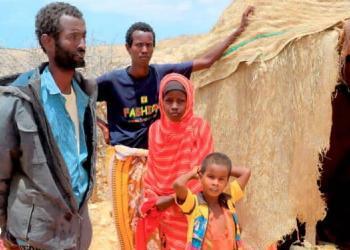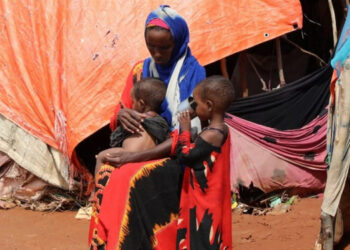


(ERGO) – Deeqo Mohamed Abshir’s living conditions in Hodale displacement camp, on the outskirts of the Somali city of Garowe, have worsened since the collapse of the small milk business she started to cope with the loss of cash aid.
She opened her small stall selling milk in January, but closed it down in early July because she had few customers due to the generally poor economy and people’s lack of spending power.
She now owes $200 to the pastoralists who supplied the milk to her.
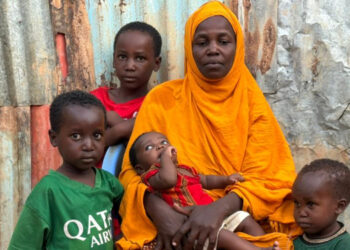
Deeqo says she is struggling to keep her family alive as they face constant hunger. Radio Ergo’s local reporter met her one afternoon sitting by a fire, where she had boiled tea for her six children gathered around her.
She said that in the past 48 hours they had cooked only twice. This time, she had borrowed sugar from a relative to make tea for her hungry children.
She explained that the $80 monthly cash assistance from the UN’s World Food Programme (WFP), which stopped in December 2024, had been vital for their survival.
“We really relied on that aid. Even if you borrowed from a shop, you knew you could repay it the next day, so it gave us relief. This morning, we didn’t cook breakfast — we only had tea. We are facing widespread poverty. What hurts us most is the lack of basics like food,” Deeqo said.
When she first heard the aid would stop, Deeqo tried to come up with a plan to support her family, as they had no relatives to turn to and her elderly husband could not work. With no capital, she asked pastoralists she knew to let her sell milk from their animals, paying them back after making sales.
For four months, this small trade just kept her family going. But as demand fell, she could no longer sell enough milk and fell into debt she could not repay.
“I wanted to sell milk to cover our daily needs. But instead of profit, it left me with debts to the pastoralists. So I gave it up, because in the end the burden falls on you. I was hoping to buy food and milk for the children and thought we could manage for some months after the aid stopped.”
Her family still had debts to pay off from the food they bought on credit, meaning further loans are impossible.
“Shopkeepers say we owe a lot — around $1,500. They call me daily, sometimes twice a day, asking for repayment,” she said.
These debts started mounting back in 2018 when Deeqo was displaced to Garowe from Dundumale, in Nugal region, after drought killed 100 of their goats and a camel that carried their loads.
About 1,000 families in Hodale camp depended on the monthly cash transfers from WFP. Most are struggling since the aid was cut.
Halimo Muse, a mother of 11, said her teashop closed in June. She had also started the business to try to replace the $80 monthly aid her family was receiving from WFP. However, there were few customers and the price of sugar kept rising.
Before it closed, the business provided a daily profit of $5, which was enough for two meals a day.
“For weeks, no one would come to us in the shop. The area is empty. So, the business didn’t work. We set it up when we lost our aid cards to get money for our daily lives and to buy water. But it didn’t last,” she said disappointedly.
Halimo, who is raising her children alone, is now in debt for $1,800. Her debt started accumulating after drought in 2019 killed her 150 goats in the rural area of Adader in Nugal region.
She said her family’s life was stable when they were receiving aid, but everything became worse since it stopped.
Fardowsa Farah, a mother of seven, has also been affected. She was displaced to Garowe in 2018 after drought in the Howd area of Nugal region killed her dozens of goats. Since her cash aid was cut, she has not been able to start a business and has had to rely on food loans. She now owes $500, and her credit has been cut off.
“I am a rural person. I don’t have any skills. And there is no one from my family to help me. I don’t even have the money to buy a single tablet today,” she said, referring to her sick child.
Fardowsa said she recently had to beg for money to take the child, who has had diarrhoea for three days, to the hospital. A hospital worker helped her, and she now owes them for the treatment.
With a lack of job opportunities in the area near the camp and no skills to work in an urban environment, many of the displaced, who are mostly former pastoralists, have no way to get out of their current crisis.