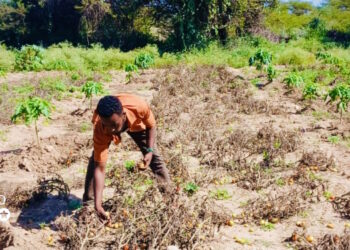


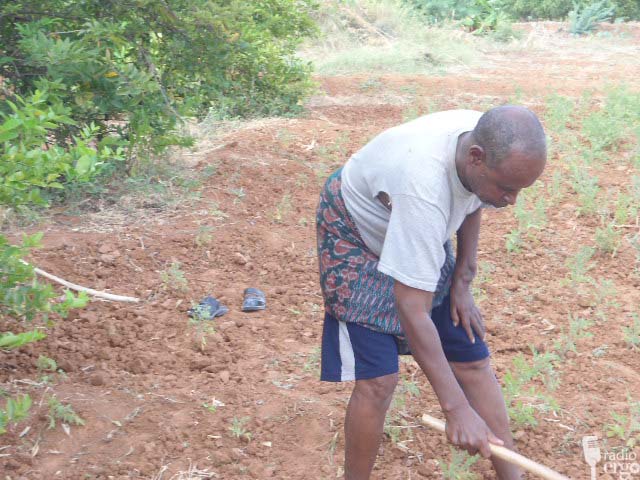
(ERGO) – As Hawo Abdi Jama, 49, watched her 800-square-metre farm in Ramaas displacement camp in central Somalia’s Mudug region wither due to lack of water, the hopes she had of harvesting sorghum this season as a reward for her hard work also shrivelled.
She was among 40 displaced families in Ramaas camp, eight kilometres from Harfo, who had ventured into farming on small plots as a means of carving out a new living. They are now experiencing hardship after the crops due for harvest in July and August dried up due to failed rainfall.
“My fruit trees dried up due to lack of water, and my farm was destroyed. This year I planted sorghum, but the drought stopped it from growing. If I had water, something would have come out of the farm, but now it is fenced off and empty. A water truck costs $50 dollars, which I can’t afford,” she said.
She owes $1,300 for seeds, pesticides, and labour, which she is unable to repay because she had no returns from the farm.
Hawo has lived in IDP camps for six years since losing all her livestock in the extreme drought of 2017 called sima – meaning equal, because nobody was spared. Her family of 13 depended entirely on her farm until it failed.
She is trying to keep the household afloat by sewing clothes at home to scrape together a living. She earns about two dollars on a good day, although it barely covers food. On days without work, she asks for credit from a local shopkeeper, who recently demanded that she first clear her current debts before receiving more.
There has been no rainfall for a year. She has even pulled some of her children out of school after failing to pay $100 in accumulated fees.
“Last year I harvested $1,700 worth of fodder and made a good income from sales. I was able to pay my children’s school fees, but this year I have been left with $2,700 in debts [including the $1,300 for farm inputs]. Seven of my children were in school, but now I can’t send even one. Their education used to be consistent, but now it is all in God’s hands,” she said.
Other women in Ramaas camp share similar struggles. Fadumo Jama Ise, who is raising 18 children including her grandchildren, said her family had been facing food shortages for the past two months, after her cooperative farm run with 15 other women failed due to water scarcity.
“Our children’s lives are terrible. They don’t have food, water, or education. Only 20 per cent of their needs are met, the rest is nothing. The shopkeepers say I owe them $1,600 in food debts,” she told Radio Ergo.
The one-hectare farm Fadumo managed with other women suffered major losses, including the $2,700 they had invested in seeds, labour, water, and farm inputs. Their crops of peppers, cabbages, tomatoes, and okra were all destroyed due to lack of rainfall.
They are now watering a few remaining crops with expensive trucked water costing $50 per truck. In one month alone, their water debt has reached $300, while deliveries are becoming scarce as trucks are diverted to other areas with better markets.
“Our watermelons and lemons dried up. Only the big trees survived. We water them with buckets from trucked water so they don’t wither off. But instead of profit, I am sinking into more debt,” she said.
Despite these losses, many of the displaced families in Ramaas camp continue to hold onto their farms, hoping for irrigation solutions that could secure their livelihoods.
Mohamed Muse Abdi, a water expert and advisor at the local NGO KAALO Aid and Development Organisation, said farmers in Puntland suffer greatly from water shortages and incur heavy losses when rain fails.
He encouraged rain-fed farmers to switch to crops that require less water and can withstand climate change.
“Modern drip irrigation is effective. It works by laying pipes across the farm in a system that delivers water drop by drop, like rainfall. Other methods include planting crops in moist, nutrient-rich soil. Crops such as sorghum, sesame, and certain pulses can grow with little water,” he explained.
Despite displacement, the families in Ramaas camp are determined to keep producing food for a living, although recurring droughts continue to drive hundreds more families away from their homes and farms each year.