

(ERGO) – A local initiative by the management of internal displacement camps in Adado, central Somalia, has enabled women without any source of income to access credit to set up small businesses.
The camp committees have forged links with local traders, persuading them to provide goods on credit to the women, with the committees acting as guarantor for the value of the goods supplied.
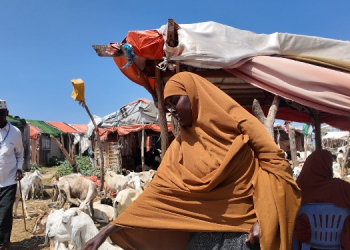
Falis Hussein Mohamed, a widow providing for 12 children, takes clothes and household items on credit from a local trader to sell door-to-door in Adado.
She has been making $3-5 a day in profit and says the change has been profound, bringing food security and hope after years of hardship.
“My business has brought a big change to my life and my family, previously I couldn’t even get meals for my children, but today thankfully they get three meals a day. The camps don’t have water taps, and before I couldn’t buy water or cook for them. Now they are eating regularly,” she said.
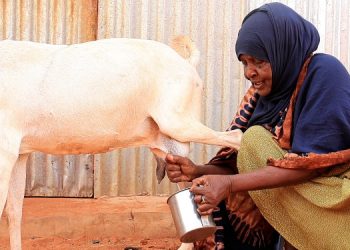
Her family has been living in Mudug camp on the outskirts of Adado since fleeing from Aad village in 2019, when her husband was killed in fighting between local residents and Al-Shabaab. At the same time, they lost 150 goats to drought and lack of pasture.
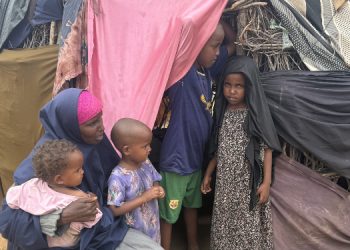
Falis and her children depended on begging for handouts from town residents to cook one meal a day. Often they went hungry and the children were malnourished.
Falis, 38, had wanted to work to make a living but had no starting point, until the camp management organised business training for women. The camp committee negotiated terms with several local traders, who agreed to act on trust.
“In the early days, it was difficult for the trader to trust me,” Falis explained. “Whenever I sold goods, I would immediately hand him whatever I had made, even if it wasn’t the full amount. He saw my honesty, and gradually he began to trust me. Now he gives me whatever stock I need, and I repay him monthly. It has become much easier.”
She spends long days walking from house to house trying to sell her goods. Although she comes home worn out, she says she is pleased to be able to support her family and hopes to improve her income further as more customers get to know her.
Another displaced woman, Farhiyo Ali Gedi, has also built a women’s clothing business that supports her family of seven children. Living in Badbaado camp for the past four years, she said her daily earnings of at least three dollars have given her new energy and hope.
“I have good hope that I will reach a higher level to open a big shop, and become a successful trader,” she said. “In the future, God willing, I want people to come to me, depend on me. I want to be someone useful, someone who can manage her life and her children’s lives.”
Farhiyo raises her children alone after separating from her husband. She had not been able to find work in town and had no skills.
Her family survived on food shared by other camp residents. At times, she could only feed her children once in 24 hours, with meagre meals lacking in nutrition.
“What changed my life is that I now work and I have a skill,” she said. “I have become a mother who can raise and support her children. A mother is ready to go through anything for her children.”
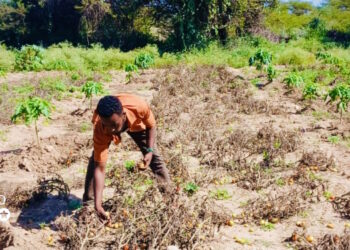
Farhiyo’s family was displaced from Amara in 2021, when drought wiped out their two-hectare farm. They have not been able to return due to continuing drought and conflict in the area.
Now, she dreams of moving her family out of the camp and building her business to reach self-reliance.
The success of these women has been made possible by the willingness of the local traders to work with the camp committees.
Fuad Abdi is one of the traders supplying goods to 15 women. At first, when approached with the idea, he worried about losing his money, but his fears were allayed after witnessing the women’s honesty and determination.
“At the beginning the women were brought to me through a guarantor, and then we got to know each other and became business partners. They took a lot of goods from me and repaid it all,” he said.
“There isn’t much profit in it for us, but we encourage them and have a special relationship with these women supporting their children and their households. The camp is a difficult place where they struggle with their children and everything else.”
So far 76 women in the camps around Adado have been trained and brought into the business initiative that started in May.
Fuad said he plans to increase the number of women he supplies on credit, so that more of them can get the opportunity. He believes this initiative can change the lives of many people in the camps and hopes other businessmen will understand its benefit in the community.