

(ERGO) – Mumino Haji Yahye lies awake at night gripped by fear, as her village has no health centre and she is due to give birth to her baby within the next few weeks.
The nearest facility is in Afgoye, about 20 kilometres away from her place in Muuri village, and she doesn’t have anyone to take her there or to look after her other children, nor does she have money for transport. She’s seen many other poor, displaced women in her area faced with similar anxieties.
“Should I give birth in Mogadishu, or will I travel? What should I do? These thoughts haunt me constantly. Financial hardship prevents me from going anywhere. I can’t afford the transportation costs and I can’t abandon my children,” she said.
She is still grieving for her 18-month-old daughter who died in June 2024 from an undiagnosed illness. Mumino noticed rashes and a high fever but couldn’t access any medical help for the child.
Mumino has high blood pressure but has been unable to obtain her prescribed medication as it’s not available at the village’s single pharmacy. She has been taking garlic, hearing that it might help.
She hasn’t had any check-ups during her whole pregnancy and doesn’t know if she and her unborn baby are well.
“I have gone through so much hardship, I haven’t received any of the vaccinations pregnant women need. I heard from people that you eat garlic to feel better so I just eat that garlic, hoping it will help,” she said.
Her husband was killed in late December 2023 during fighting between government forces and Al-Shabaab militants. He died whilst he was working on their five-hectare farm in Bariire, about 20 kilometres west of Muuri.
Mumino has been struggling alone to provide for herself and her eight children selling vegetables that she spreads out on a sack on the ground in the local market.
“I am the only one working for the family now, there is no one else. I sell whatever vegetables I can find in the market. Sometimes we get something, sometimes we go without. During the day we might have one meal. If we find food at night we eat. If not, we sleep hungry,” she told Radio Ergo.
“This should be my time to rest, but I have no choice other than to keep working to feed my children, doing jobs I’ve never done before.”
The family fled to Muuri in early 2024 after being displaced by conflict and drought from their home in Dhanane, Lower Shabelle region.
The poor road to Muuri becomes impassable at dusk, cutting off any chance of emergency medical help after dark. Women and children are particularly vulnerable.
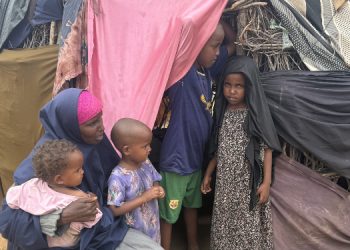
Muuri resident, Mahmud Hassan Ali has been tending to his two-year-old son in the shade of a tree outside their hut. The boy has been sick since April 2024 with high fevers, rashes and extreme weakness.
“The fever lasts for days and nights without stopping,” Mahmud described. “My son has become so weak he can’t even cough properly. Rashes cover his body.”
Mahmud tried selling his two goats at the market to raise money for medical treatment, but couldn’t find buyers because the animals were too emaciated.
His farming income has dwindled to just $1-2 per day due to poor seasonal rains, so there isn’t enough food.
“My son’s condition worsens daily,” Mahmud said. “The biggest problem is we have no health facility here at all.”
A surgeon at Banadir Mother and Child Hospital in Mogadishu, Dr Abdiasis Ismail, hearing the symptoms described by Muuri residents, suspected the children might have measles or chickenpox.
Muuri village chairman, Aynashe Abdullahi, said that at least 20 women had died in childbirth since January 2024, as well as 10 children from undiagnosed illnesses.
The village’s single well cannot meet demand, forcing residents to pay 5,000 Somali shillings per jerrycan or walk to collect unsafe water from the Shabelle River six kilometres away.
Some 900 families arrived in Muuri in mid-June 2024, after fleeing nearby conflicts. This has overwhelmed the villages already scarce resources.
Education has collapsed since Al-Shabaab burned the local school. Children now try to study outdoors without books, pens or shelter from sun and rain.
“We have begged the South West State administration and humanitarian organisations for a health centre. Our people are suffering terribly. They need help immediately,” the village chairmn appealed.