

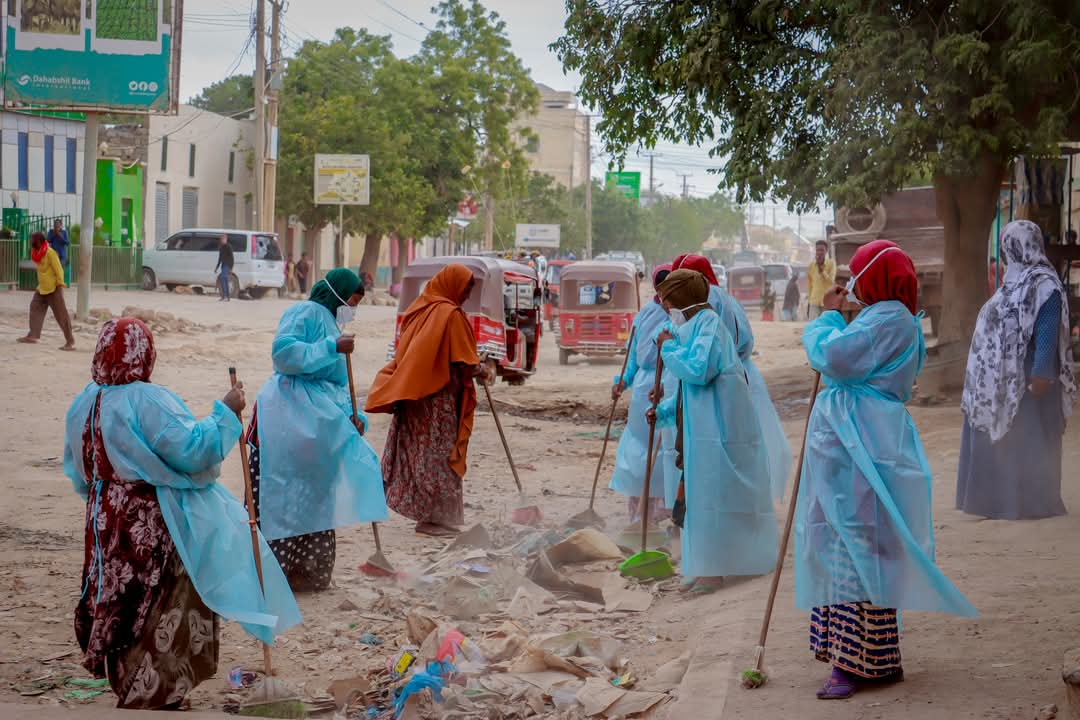
(ERGO) – Hafso Ibrahim Salad has managed to support her family since securing a street cleaning job with the municipal administration of Baidoa, Bay region, with a monthly salary of $150.
She is among 60 people, including 10 women, who were employed last September from low-income and internally displaced households.
Hafso told Radio Ergo that life had improved for her seven children, whose father died in 2021.
“Since getting this job, my daily life has improved tremendously. I receive a decent salary that fully supports our living. My children no longer have to worry about food. I am truly grateful to the South West State government,” Hafso said.
Hafso, 44, was able to enroll two of her children in Al-Marifa school in October for the first time, as she can now afford the $20 monthly fees.
“My children’s education is going very well now. We used to struggle a lot, I would gather firewood just to survive. But now, I no longer have to do that. I can provide food, clothing, and education for my children without worry,” she said.
Hafso works full-time, collecting and disposing of waste and cleaning the streets. She was unexpectedly recruited for the job through a relative in the city. She is glad to leave behind the five kilometre treks into the bush she used to make searching for firewood to sell.
“The difference between my old life and my current one is huge. Now, I have a reliable income, whereas before I never knew where my next meal would come from. I always feared for my safety when collecting firewood, but now I no longer have to worry about that.”
Hafso and her children have lived in Usbole displacement camp since 2021 when they fled Hudur, a town 180 kilometres from Baidoa under siege from Al-Shabaab. The death of her husband, who supported the family as a truck loader, magnified the trauma of their displacement.
Another widow, Binto Adan Ishaaq, 56, told Radio Ergo that working as a cleaner for the municipal administration has given her the first steady income she has ever had.
She says the six-hour shifts daily are manageable, and the income is sufficient to support her seven children. Her husband died of hepatitis in 2018. They often went to bed hungry, but now they can afford three meals a day.
“Now we lack nothing. We are healthy, and I have a stable job. Previously, we would only cook once at night. My children would go to bed hungry, sometimes drinking water to fill their stomachs. But now, as I speak, I have half a sack of rice, half a sack of flour, half a sack of sugar, and ten litres of cooking oil stored in my home,” Binto said.
She recently moved from Hagarow displacement camp, where she had lived for three years, to Bula Nuriyo neighbourhood, where she rents a two-room iron-sheet house for $30 a month. It is an upgrade from the camp, where she lacked adequate shelter and water.
She enrolled three of her children in school last October, paying $15 monthly in school fees. She managed to save $200 towards her necessary surgery at Shafi Hospital in Mogadishu.
“I had $200 saved when I fell sick. My children stepped in to help with my work, but I needed $1,300 for the surgery. I didn’t have the full amount, so well-wishers contributed the rest, though I still owe $300,” she explained.
She said she was introduced to the job opportunity through a market vendor’s family connection.
The director of hygiene at Baidoa municipal government, Abshir Ali Hussein, said displaced and low-income people struggled to find work due to a lack of education and skills.
He emphasised that the administration prioritised creating simple job opportunities to provide financial relief for struggling families. Many people applied for the cleaning jobs, but he said that priority was given to the most vulnerable individuals, especially those struggling to afford even firewood for cooking.
“When people are displaced, their lives become unstable. Our goal is to integrate displaced people into the community by resettling and employing them. Providing jobs for low-income individuals is a key part of this process,” Abshir said.
He added that more vulnerable individuals would be employed in the coming years.
Many displaced families in Baidoa face severe food and water shortages and inadequate shelter. Despite years in the camps, they have not been permanently resettled and lack means of earning a living.