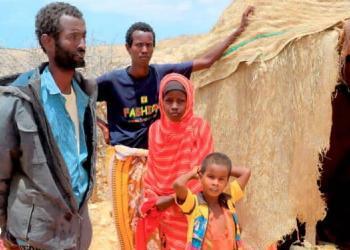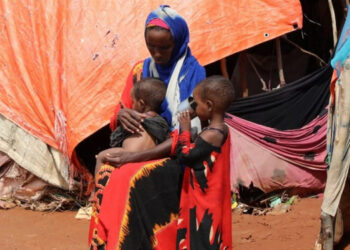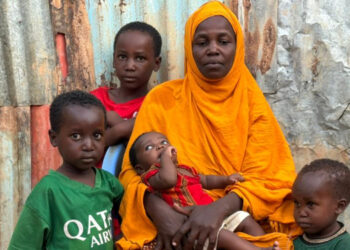


(ERGO) – Fadumo Mohamed Abdiqadir and her five children are struggling to secure enough food for even one meal a day due to the scarcity of grass that she relies on to sell for her income.
Over the past three months, drought has severely limited the availability of grass on farms and open land particularly in Lower Shabelle region. Hundreds of people making a living collecting and selling grass are now facing extreme hardships.
Fadumo, who lives in Juba camp in Weydow in the capital’s Garasbaley district, still sets out most mornings to walk over 20 kilometres to a field to gather grass for sale. Often she spends eight hours collecting only a bundle of grass that earns her very little income.
“There is no grass. If you manage to find some, only one or two people are interested, and they offer a low price. Every day I collect grass from the fields. Previously, I could earn $4 or $5 for my children, depending on what God provided. But now, we have nothing,” she lamented.
Grass when it was abundant could be gathered for free but since the drought farmers and landowners have started charging $3 to $5 per bundle.
In the past two months, she has accrued $15 in debt for grass she purchased but couldn’t sell due to its dryness. Customers now prefer greener grass, leaving her stock unsold.
Fadumo fears that grass will eventually disappear entirely from the fields, making life even more challenging for her children.
“Sometimes, I can’t even make $1.50 in a day. Sometimes I have to cover the shortfall myself, using what little I have set aside for the children. This isn’t sustainable, but it’s all I can do. We don’t have any other work,” she said.
Three previous years of drought ruined her own family’s farm devastated and forced her out of her home in Burhakaba, Bay region, in 2023. She moved to Juba IDP camp in Garasbaley seeking work, whilst her husband stayed behind to safeguard their house.
She found an opportunity in grass collection, which then provided a decent income of $10 to $15 per day. This income helped her family recover from their displacement crisis, but now they are slipping back into hardship.
Mohamed Aden Isaq, a father of eight, who has lived in Afgoye for over 20 years, also relied on collecting and selling grass for his livelihood. However, since mid-2023 he has faced financial difficulties due the scarcity of pasture. He now works only two days a week in the fields of Afgoye gathering scarce amounts of grass.
“This situation has placed an additional burden on us. It has reduced the profits we used to make and left my family facing food shortages. We can only cook one meal a day,” he said.
Before the drought, Mohamed sold grass in various districts of Mogadishu, catering to livestock owners. However, he had to stop this business two month ago due to the lack of grass.
“There is nowhere else to go. I can’t work in construction, and farming has come to a halt. The only option I had is grass collection, but it’s no longer profitable,” he said.
Severe and ongoing drought has dealt a double blow to many, not only devastating their own farms and original livelihoods but also ruining their once profitable sales in animal fodder.
Isaaq Aden Abdi, a 26, another grass seller in Mogadishu, expressed despair over the instability of his work. In recent weeks, he has returned home empty-handed, unable to provide for his family of six. Without any skills to work in Mogadishu, he has been forced to borrow food for his family.
“We can’t afford three meals a day, only one. Borrowing is the only option, and we pay it back whenever we can. Right now, I owe $20 for food,” he said.
Isaaq, his wife, and five children live in Fayarabey camp in Garasbaley, where they arrived six years ago after fleeing drought in Burhakaba, Bay region. His farm there once produced crops like millet, beans, and maize.